
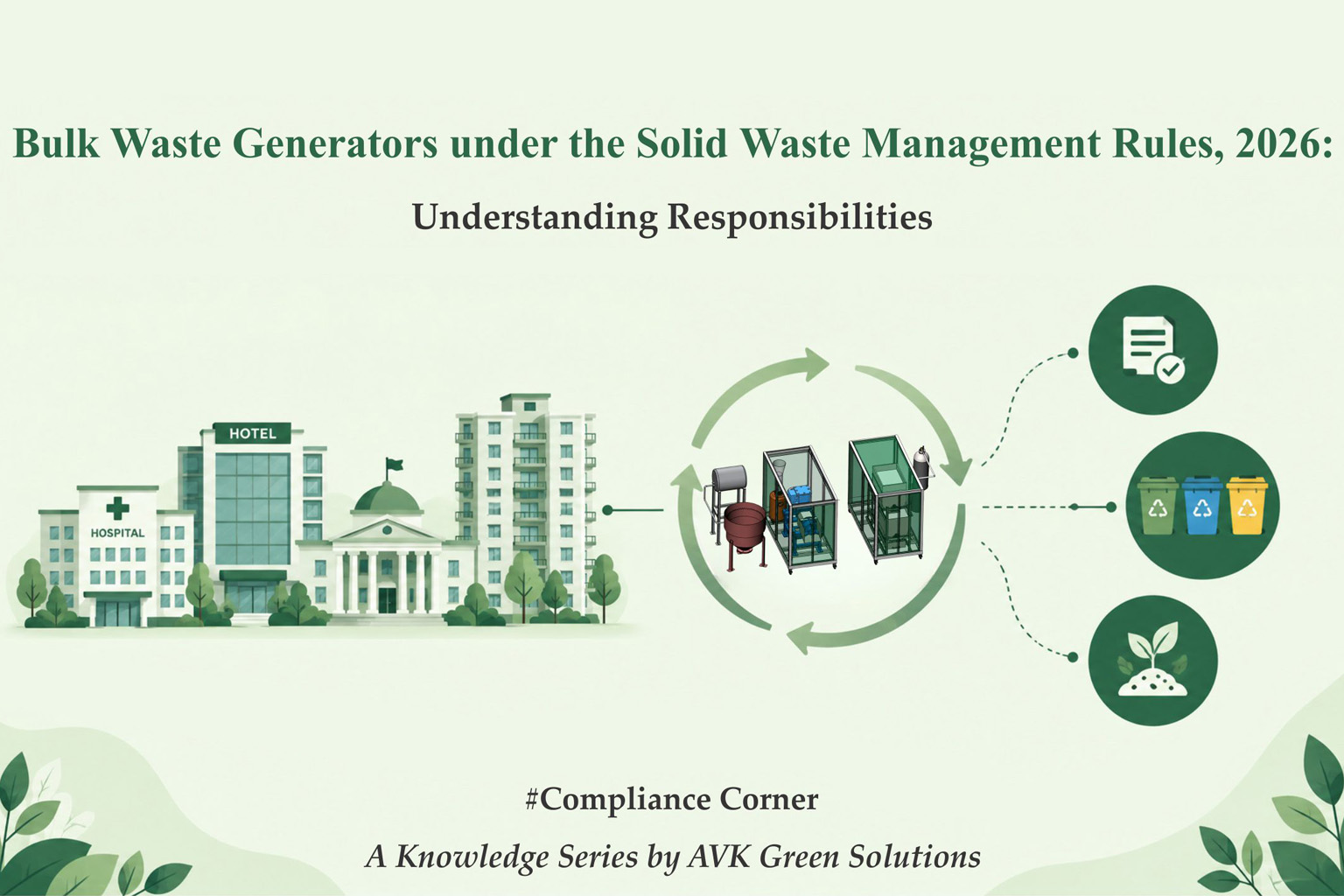
Compliance Corner #2
Understanding Responsibilities
Waste management is no longer limited to the collection and disposal of waste. The Solid Waste Management Rules, 2026 place greater responsibility on large waste-generating establishments to ensure that the waste generated by them is properly segregated, processed, collected, transported and scientifically managed.
One of the important provisions under the Rules is the recognition of Bulk Waste Generators (BWGs) and the introduction of specific responsibilities.
Understanding who qualify as a BWG—and what they are required to do—is essential for compliance.
Who is a Bulk Waste Generator?
Under the Solid Waste Management Rules, 2026, a Bulk Waste Generator covers specified entities that satisfy at least one of the following criteria:
- Building floor area: 20,000 sq. m. or above
- Water consumption: 40,000 litres per day or above
- Solid waste generation: 100 kg per day or above
This means that an entity does not necessarily need to meet all three criteria. Meeting any one of the prescribed thresholds can bring the entity within the definition of a Bulk Waste Generator, provided it falls under the categories specified in the Rules.
Which Establishments are covered?
The Rules broadly cover three major categories of Bulk Waste Generators.
1. Institutional Users
These include:
- Central Government departments and undertakings
- State Government departments and undertakings
- Local bodies
- Public Sector Undertakings and private companies
- Schools, colleges, universities and other educational institutions
- Community places and similar establishments
2. Commercial Users
The commercial category includes a wide range of establishments such as:
- Railways, bus stations and depots
- Airports and ports
- Hotels and restaurants
- Hospitals and nursing homes
- Wholesale markets, including agricultural, horticultural, fish and meat markets
- Marriage and banquet halls
- Tourist spots
3. Residential Societies
Residential societies are also specifically included within the scope of Bulk Waste Generators when they satisfy at least one of the prescribed thresholds.
Therefore, BWG compliance is not restricted to commercial establishments. Large residential communities also have an important role to play in implementing decentralized waste management.
What are the Responsibilities of a Bulk Waste Generator?
The Rules place several responsibilities on BWGs. These responsibilities go beyond simply handing over waste to a municipal collection vehicle.
1. Registration with the Local Body
Every Bulk Waste Generator is required to register with the concerned local body through the centralised online portal.
The registration certificate will specify the conditions that must be fulfilled for the registration to remain valid.
If there is any change in the information submitted during registration or in the conditions specified in the registration, the BWG is required to notify the concerned local body.
2. Proper Handling of Different Waste Streams
A BWG must make arrangements for the collection and handing over of:
- Dry waste
- Sanitary waste
- Special care waste
These wastes are to be handed over to the local body or an agency authorised by the local body.
This establishes an important principle: different categories of waste cannot simply be mixed together and handed over as one waste stream.
3. Wet Waste Must Be Managed at Source
One of the key responsibilities under the Solid Waste Management Rules, 2026 is the decentralized management of wet waste and horticulture waste, wherever applicable.
Bulk Waste Generators (BWGs) are required to make appropriate arrangements for the collection and decentralized processing of wet waste generated at their premises through suitable technologies, includes and these technologies mandated under the Solid Waste Management Rules, 2026:
- Vermicomposting (Not suitable for large-scale processing due to space requirements.)
- Biomethanation (Decentralization is difficult at small scale, Compost is not produced)
- Anaerobic Digestion / Microbial Composting (Perfect solution for decentralization and to obtain nutrient rich organic manure)
The objective is to ensure that organic waste is processed as close to its point of generation as practicable rather than being transported along with mixed waste for disposal.
4. New BWGs Must Establish Wet Waste Processing Facilities
The Rules specifically provide that all new Bulk Waste Generators must set up and operate a wet waste processing facility of adequate capacity.
The facility must have sufficient capacity to ensure the processing of the complete wet waste generated by the premises, including horticulture waste where applicable.
This makes decentralized processing an important component of planning for new large residential, institutional and commercial developments.
5. Provision for Existing BWGs
The Rules also recognise that some existing Bulk Waste Generators may not be able to establish and operate decentralized wet waste processing facilities.
In such cases, existing BWGs may obtain an exemption from the local body.
However, the responsibility does not end with obtaining an exemption.
Such BWGs are required to procure Extended Bulk Waste Generator Responsibility Certificates from the concerned local body for processing wet waste equivalent to the complete quantity of wet waste generated by them.
Thus, the Rules create a mechanism through which existing BWGs can fulfil their waste-management responsibility even when on-site processing is not feasible.
Understanding Extended Bulk Waste Generator Responsibility (EBWGR)
A major feature of the Solid Waste Management Rules, 2026 is the introduction of Extended Bulk Waste Generator Responsibility.
Under EBWGR, Bulk Waste Generators are responsible for:
- Processing their wet waste and
- Ensuring environmentally sound management of dry waste, sanitary waste and special care waste.
The total EBWGR obligation for the solid waste generated by a BWG will be calculated according to norms issued by the Central Pollution Control Board, in consultation with the concerned ministries and departments.
This shifts the focus from merely generating and handing over waste to taking responsibility for its environmentally sound management.
What if a BWG Cannot Process Wet Waste On-Site?
Where wet waste is not processed by the Bulk Waste Generator itself, the Rules require the BWG to procure Extended Bulk Waste Generator Responsibility Certificates from the local body.
These certificates relate to the environmentally sound management of waste through collection and transportation and sending the waste to a registered waste processing facility for further processing and treatment.
This creates an accountability mechanism between the waste generator, local body and registered waste-processing facilities.
Do Not Engage with Unregistered Waste Entities
Another important requirement is that a Bulk Waste Generator must not engage with any entity that does not have the registration mandated under the Rules.
Therefore, BWGs should verify the registration and authorisation status of agencies, waste collectors and processing facilities before handing over waste to them.
This is particularly important for large establishments that engage private waste-management agencies.
Annual Reporting and Compliance
Compliance under the Rules is not limited to registration.
Every registered Bulk Waste Generator is required to submit an online annual report in the format prescribed by the Central Pollution Control Board.
The annual return is to be submitted by 30 June every year and must include information relating to the BWG’s Extended Bulk Waste Generator Responsibility obligations, including procurement of EBWGR certificates for the calculated quantity of solid waste generated.
The annual returns are also to be submitted to the concerned local body for further processing and are to be made available in the public domain on the local body’s website.
This brings greater transparency to BWG compliance.
From Waste Generators to Resource Managers
The Solid Waste Management Rules, 2026 represent an important shift in the way large waste generators are expected to manage waste.
For a Bulk Waste Generator, compliance is no longer simply about placing waste outside the premises and expecting it to be collected.
The approach is increasingly based on:
Generate → Segregate → Process → Recover → Responsibly Manage Residual Waste → Report
Wet waste can be processed through composting or biomethanation, while dry waste and other waste streams can be directed towards appropriate authorised systems for recovery, treatment or disposal.
This decentralized approach can reduce the quantity of waste requiring transportation, improve resource recovery and encourage establishments to take greater responsibility for the waste they generate.
A Compliance Checklist for Bulk Waste Generators
Every BWG should consider the following questions:
- Does our establishment meet any of the prescribed BWG thresholds?
- Have we registered with the concerned local body through the centralised online portal?
- Are we properly segregating different waste streams?
- Do we have adequate arrangements for wet waste and horticulture waste processing?
- If on-site wet waste processing is not feasible, have we obtained the applicable exemption and fulfilled our EBWGR obligation?
- Are we engaging only with registered/authorised waste-management entities?
- Are residual waste and inert materials being handed over appropriately?
- Are we maintaining records required for annual reporting?
- Have we submitted our annual return by 30 June?
- Are our EBWGR obligations being fulfilled and documented?