Category: AVK Green Solutions Pvt. Ltd

  • Swachh Maharashtra Abhiyan (Urban) 2.0

    Swachh Maharashtra Abhiyan (Urban) 2.0

    Swachh Maharashtra Abhiyan (Urban) 2.0

    Swachh Maharashtra Abhiyan (Urban) 2.0

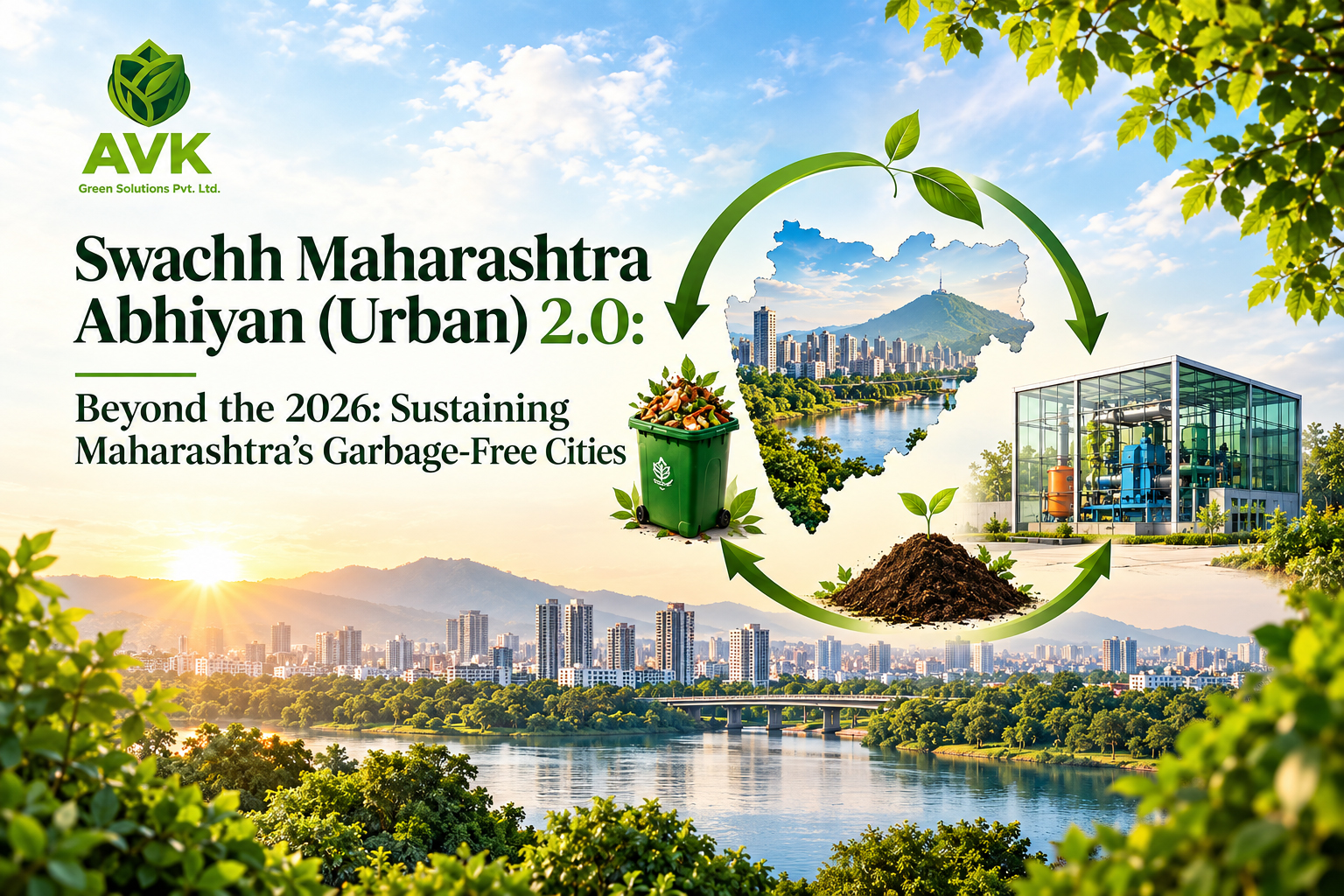
    Beyond the 2026: Sustaining Maharashtra’s Garbage-Free Cities

    Beyond the Mission: Sustaining Maharashtra’s Garbage-Free Cities

    The journey towards Garbage-Free Cities does not end with the completion of a mission period. The real measure of success lies in our ability to sustain the progress achieved and make cleanliness a permanent part of urban life. Over the past five years, Maharashtra’s cities have taken significant steps towards improving waste management, strengthening systems, encouraging source segregation and involving citizens in Swachhata initiatives. As we look beyond 2026, the challenge is no longer simply to achieve the status of a Garbage-Free City, but to ensure that this status is maintained year after year.

    This raises an important question: How do we sustain the progress achieved between 2021 and 2026? Infrastructure and systems can be established by governments, but their long-term success depends on consistent implementation and public participation. If citizens stop segregating waste, illegal dumping begins again, or communities lose interest in cleanliness initiatives, the progress made over the years can quickly come under pressure. Therefore, while the Mission may conclude in 2026, the collective responsibility to maintain a Garbage-Free City must become an ongoing—because ‘The mission ends, but the commitment continues.’

    From Government Mission to People’s Movement

    A clean city cannot be created by government efforts alone. While municipal bodies are responsible for providing infrastructure, collection systems, processing facilities and services, the success of the entire waste-management system begins at the household level. Every resident has a role to play in determining what happens to the waste generated every day.

    The next phase of Maharashtra’s Swachhata journey must therefore move from a government-led programme towards a people-led movement. Resident welfare associations, schools, colleges, NGOs, corporate organisations, community groups and local citizens can become active partners in maintaining cleanliness. Source segregation, responsible disposal and participation in community initiatives should not be viewed as occasional activities linked to a campaign or competition. They need to become everyday habits. True transformation begins when Swachhata becomes a shared responsibility rather than someone else’s duty—because a ‘Clean Maharashtra begins with every citizen.’

    What Happens After the Mission Ends?

    The progress achieved over the past five years cannot be taken for granted. If momentum is lost, cities may once again face challenges that they have worked hard to overcome. Uncontrolled dumping can return to roadsides, open spaces and water bodies. Increasing quantities of waste can put additional pressure on landfills and waste-processing facilities. Rivers, lakes and other water bodies can become vulnerable to pollution, while poor waste management can also create public-health and environmental concerns.

    The lesson is clear: Maintaining Progress Requires Continuous Action. A clean street today does not guarantee a clean street tomorrow. A successfully processed waste stream today does not guarantee responsible waste management in the future. Continuous monitoring, citizen participation, efficient systems and responsible behaviour are essential to prevent cities from slipping backwards.

    Therefore, sustaining Maharashtra’s Swachhata achievements requires continued commitment to protect the progress made and build upon it—because ‘Preserving progress today is the foundation for greater progress tomorrow.’

    The Next Five Years: Maharashtra’s Roadmap to Zero-Waste Cities

    Looking ahead, Maharashtra has an opportunity to move beyond the conventional approach of simply collecting and disposing of waste. The future lies in creating cities where waste is reduced, reused, recycled, recovered and treated as a resource rather than something destined for disposal.

    This transition requires greater emphasis on the principles of the circular economy, where materials remain in use for as long as possible and the generation of waste is minimised. Decentralised waste-processing systems, composting, biogas generation, recycling, resource recovery and scientific management of different waste streams can help cities reduce their dependence on landfills.

    The next five years can therefore be about moving from waste management to resource management—creating urban systems that are cleaner, more efficient and more sustainable. A zero-waste city may be an ambitious goal, but every reduction in waste generation, every tonne diverted from landfill and every material recovered represents a step towards that vision.

    The Future of Waste: From Garbage to Resource

    For decades, waste has largely been viewed as something that needs to be collected and removed. But the future demands a different perspective. What we call “waste” often contains materials that still have value. Organic waste can become compost or biogas. Dry recyclable waste can enter recycling chains and return to the economy as useful material. Construction and demolition waste can be processed and reused in appropriate applications.

    This shift in perspective can also create new opportunities for livelihoods, entrepreneurship and local economic activity. Waste-processing facilities, recycling enterprises, composting units, resource-recovery systems and other circular-economy solutions can contribute to both environmental sustainability and economic development.

    The goal, therefore, should not simply be to find a place to put our waste. The goal should be to ensure that as little waste as possible becomes waste in the first place. Waste Is Not a Problem; It Is a Resource in the Wrong Place.

    Citizen Actions That Will Shape Maharashtra’s Future

    Ultimately, the future of Maharashtra’s cities will be shaped by millions of small decisions made every day. A household that segregates its waste correctly, a citizen who avoids unnecessary single-use plastic, a community that composts its organic waste, or a resident who disposes of sanitary and hazardous waste responsibly may appear to be taking a small step. Collectively, however, these actions can create a significant transformation.

    Citizens can contribute by segregating waste at source, reducing unnecessary consumption, reusing materials, composting organic waste where feasible, avoiding single-use plastics and ensuring that sanitary, hazardous and other special waste reaches the appropriate collection system. Participation in local cleanliness initiatives and encouraging others to adopt responsible practices can further strengthen community ownership.

    The journey towards Garbage-Free Cities is therefore not the responsibility of one department, one organisation or one mission. It is a continuous journey that depends on the choices made by all of us. Small Actions Today, Cleaner Cities Tomorrow.

    Inspiring Story of a Navi Mumbai: Transforming Waste Management into Urban Excellence

    Case Study: Navi Mumbai – A Model for Sustainable Urban Cleanliness

    Navi Mumbai was born out of the planning to provide a well-planned alternative to the overcrowded island city of Mumbai. The benefits of that planning are reflected in the cleanliness of the city even more than 20 years later. The Navi Mumbai Municipal Corporation (NMMC) has consistently ranked among the top three positions in Swachh Survekshan for several years due to its modern waste management infrastructure and the active participation of its citizens.

    The city has achieved Open Defecation Free Plus (ODF+) status and has an efficient door-to-door waste collection system across all wards. The lower population density of Navi Mumbai, compared to old Mumbai, also facilitates its cleanliness, making it easier to monitor and enforce regulations.

    Navi Mumbai is increasingly becoming a preferred destination for residents. It is considered a desirable place to live for families because of its clean air, well-maintained streets, and efficient civic services.

    Recognition and Achievements of Navi Mumbai

    • Navi Mumbai is Maharashtra’s top-rated city for garbage-free status, holding a 5-Star Rating with a score of 5467.89 under the Ministry of Housing and Urban Affairs (MoHUA) Star Rating Protocol in 2020.
    • Navi Mumbai also retained the highest Seven-Star Garbage-Free City Rating as well as the highest Water Plus Rating as of 2024–25.
    • The 5-Star Rating further strengthened Navi Mumbai’s position as one of the cleanest cities in Maharashtra.

    Regarding the Garbage-Free Cities (GFC) Certification, the star rating conditions are based on 25 key parameters, further classified as mandatory, desirable, and essential, including plastic ban implementation, waste processing, and maintaining garbage-free water bodies. Navi Mumbai has a population of nearly 11 lakh residents.

    • Many eco-friendly measures, including the segregation of wet and dry waste and the installation of waste decomposition facilities in schools and gardens, have been actively implemented across the city.
    • Navi Mumbai has emerged as Maharashtra’s only representative in the newly launched ‘Super Swachh League’ under Swachh Survekshan 2024–25 for cities with a population exceeding 10 lakh.

    What Makes Navi Mumbai Different?

    100% Source Segregation & Door-to-Door Collection

    Every household and commercial establishment segregates wet, dry, and domestic hazardous waste at the source, supported by a fleet of GPS-tracked waste collection vehicles.

    Advanced Waste Processing

    The city operates robust Material Recovery Facilities (MRFs), composting plants, and wet and dry waste processing units to recycle and recover a significant portion of its daily waste instead of allowing it to accumulate in landfills.

    Water+ Certification

    Navi Mumbai maintains high standards in treating 100% of its wastewater and sewage. The city actively recycles and reuses treated water for public gardens, construction activities, and industrial purposes.

    Meeting the Aspirational 7-Star Criteria

    Beyond basic cleanliness, the 7-Star protocol requires compliance with advanced parameters such as complete remediation of legacy dumpsites, restrictions on single-use plastics (below 50 microns), clean water bodies, regular cleaning of public and commercial spaces, city beautification initiatives, and scientific processing of sanitary waste.

    This comprehensive approach has enabled Navi Mumbai to emerge as a benchmark for sustainable urban cleanliness and solid waste management in Maharashtra.

    The Journey Ahead

    Maharashtra’s journey towards Garbage-Free Cities has demonstrated what can be achieved when vision, systems and participation come together. The next challenge is to ensure that this progress becomes permanent.

    The years ahead should not be defined merely by maintaining a cleanliness status or achieving another milestone. They should be defined by creating cities where responsible waste management becomes a natural part of everyday life—where citizens understand the value of resources, communities take ownership, institutions work together and waste is increasingly prevented, recovered and reused.

    “The mission may have a timeline. The vision of a Clean Maharashtra lives on.”
  • From Mission to Impact – A Five-Year Journey Towards

    From Mission to Impact – A Five-Year Journey Towards

    Swachh Maharashtra Abhiyan (Urban) 2.0
    From Mission to Impact – A Five-Year Journey Towards
    ‘Garbage-Free Cities’

    “Empowering Communities with a unified Vision: One Mission towards Garbage-Free Cities”
    Urbanisation has brought rapid growth to Maharashtra’s cities, but it has also increased the generation of solid waste, wastewater and sanitation-related challenges. Managing these challenges requires more than collection and disposal—it requires scientific treatment, resource recovery, sustainable sanitation infrastructure and active participation from citizens. With this objective, the Swachh Maharashtra Abhiyan (Urban) 2.0 was implemented for the period 2021–2026, with a focus on strengthening urban sanitation and waste-management systems across the state. The mission aimed to move cities towards cleaner and more sustainable urban environments through improved waste management, sanitation, used-water management, behaviour change and institutional capacity building.
    As the mission period comes to an end, it is important to look beyond the targets and examine what was implemented, what changed and what lessons can guide the next phase of urban waste and sanitation management in Maharashtra.

    From Waste Collection to Resource Recovery
    Every day, cities generate large quantities of municipal solid waste—from households, markets, commercial establishments, institutions and public spaces. But the challenge does not end with collecting this waste. What happens after the waste leaves our homes is equally important…
    When wet waste, dry waste, sanitary waste and other waste streams are mixed at the point of generation, the entire waste-management chain becomes more difficult. Materials that could otherwise be composted, recycled or recovered become contaminated. The mixed waste then requires additional handling and processing, and a portion may ultimately move towards disposal.This is where the fundamental principle of scientific solid waste management becomes important: “Segregation is not the end of waste management. It is the beginning.”
    The challenge, therefore, is not simply to collect more waste. It is to ensure that waste is segregated, collected separately, processed scientifically and recovered wherever possible.This principle was central to the vision of ‘Swachh Maharashtra Abhiyan (Urban) 2.0’.

    Swachh Maharashtra Abhiyan (Urban) 2.0
    (Duration – 2021 to 2026)

    The guidelines for implementing “Swachh Bharat Mission (Urban) 2.0” as a mission in the country have been issued by the Ministry of Housing and Urban Affairs, Government of India. It was released on 25 October 2021. According to this, the mission must be implemented in all legally established urban local bodies in the country. In line with this, a campaign “Swachh Maharashtra Abhiyan (Urban) 2.0” has been approved to be implemented in the state.
    Core objectives:

    • Garbage-Free Cities: Make all urban cities completely garbage-free.
    • Sustainable Solid Waste Management: Going beyond just waste collection to achieve 100% source segregation (wet, dry, sanitary and hazardous waste) and complete scientific processing, door-to-door waste collection, and scientific processing of solid and liquid waste.
    • 3R Principles: Implement Reduce, Reuse, and Recycle mechanisms across all municipal bodies.
    • Dumpsite Remediation: Clean up and remediate legacy waste dumpsites.

    About the campaign:

    In order to achieve the ultimate goal of a “Garbage Free” Urban India, the implementation of the components of the “Swachh Maharashtra Mission (Urban) 2.0” has been supplemented by the experience of the earlier “Swachh Bharat Mission” as well as by the Ministry of Housing and Urban Affairs, Government of India. The Operational Guidelines issued on 25th October, 2021 are being relied upon. Accordingly, under the “Swachh Maharashtra Abhiyan (Urban) 2.0,” a vision to achieve “Garbage Free City” status for all cities has been envisaged with a target to achieve the Sustainable Solid Waste Management.

    What Does a Garbage-Free City Really Mean?
    A garbage-free city is not simply a city where waste is collected regularly or where streets and public spaces appear clean. It requires a system in which waste is segregated at source, collected separately, scientifically processed, and recovered wherever possible, with minimal dependence on disposal.
    India generates about 1,70,000 tonnes (1.7 lakh tonnes) of municipal solid waste every day and nearly 40% not formally processed, according to recent reports by the Central Pollution Control Board (CPCB).As these quantities increase with urbanisation, cities need systems that can manage waste throughout its entire lifecycle.
    When waste is mixed at source, recyclable and biodegradable materials can become contaminated, reducing their recovery potential and making subsequent processing more difficult. Therefore, achieving cleaner and more sustainable cities requires a shift from “collect and dispose” to “segregate, process and recover.” This systemic shift formed an important part of the approach under Swachh Maharashtra Abhiyan (Urban) 2.0.


    Why Sustainable Solid Waste Management Matters for Maharashtra:

    For a rapidly urbanising state like Maharashtra, solid waste management is a continuous urban challenge. ‘Maharashtra’ is India’s largest waste creator. Maharashtra generates 15% of India’s trash, with the state contributing 21,867 tonnes per day and 68% waste is not getting treated.
    According to Central Pollution Control Board (CPCB), the treatment is currently inadequate for Maharashtra. There are several locations where waste is being dumped in the open. Meanwhile, Mumbai, which has about 10% of the state’s pollution, produces 44% of the state’s trash. In cities such as Mumbai, there is no substantial processing at source or at dumping grounds. This waste is generated every day by households, commercial establishments, institutions, markets and other urban activities. If this waste is not properly segregated, collected, processed and disposed of, it can create multiple environmental and urban-management problems.
    Traditional waste management has often followed a linear pattern:

    Generate → Collect → Transport → Dump

    Such a system places significant pressure on land available for disposal and does not fully utilise the resources present in waste. When waste is dumped without adequate scientific treatment or containment, it can lead to foul odour, air and water pollution, pest and vector breeding, and the generation of leachate that can contaminate surrounding soil and water sources.
    A sustainable approach requires a different chain:

    Generate → Segregate → Collect → Process → Recover → Reuse

    This shift forms the foundation of scientific solid waste management. It represents a fundamental change in how cities approach solid waste management—from simply moving waste away to managing it as a resource. Segregation enables better processing, processing enables resource recovery, and recovery creates opportunities for reuse and recycling. 

    What is Sustainable Solid Waste Management as per Swachh Maharashtra Abhiyan (Urban) 2.0?

    The objective of this component is to make all cities clean and garbage free by 100 per cent scientific treatment of city solid waste. It includes the following items:
    1. To ensure cleanliness and hygiene of public places and to make all cities clean and garbage free    with 100 per cent standardized solid waste management practices.
    2. Reducing air pollution during solid waste management.
    3. Reducing the use of single-use plastics. The following entities will be eligible to receive funds under this: –

    • MRFs, waste transfer stations, compost plants, processing facilities, plastic waste processing facilities. Establishing waste treatment facilities such as waste-to-energy plants, sanitary landfills, etc.
    • Factors include procuring mechanical sweeping machine equipment and setting up processing facilities for effective management of construction and demolition waste.
    • Biomining / capping of legacy waste sites in all cities

    Current situation:

    Solid Waste Management Out of the solid waste generated in the urban local bodies of the state, a total of 22503 MT (Metric Tonne) / day is being processed in India. It is producing 1200 MT of compost every day. A total of  230 local bodies have been awarded the “Green City Compost brand”. 

    A Shift towards Sustainable Urban Waste Management:

    The objective of this component is to make all cities clean and garbage free by 100 percent scientific treatment of city solid waste. It includes the following items:
    To ensure cleanliness and hygiene of public places and to make all cities clean and garbage free with 100 per cent standardized solid waste management practices. Reducing air pollution during solid waste management. Reducing the use of single-use plastics.

    Changes in information education dissemination and public awareness / citizen engagement:

    The Objective: The objective of these components is to intensify the mass movement to achieve the goal of “Garbage Free” cities and to ensure awareness generation by reaching out to the citizens at large to institutionalize clean behaviour and related actions and to ensure awareness generation by reaching out to the citizens at large to intensify the mass movement and institutionalize clean behaviour and related actions to achieve the goal of “Garbage Free” cities. Under this, Indian Swachhata League 1.0 and 2.0, Swachhata Pledge, Swachhotsav, Swachhata Yatra, Swachhata Hi Seva, Safaimitra Suraksha Shivir, etc. campaigns have been undertaken.

    The Solid Waste Management Approach under SBM-U 2.0

    Under Swachh Maharashtra Abhiyan (Urban) 2.0, the focus on solid waste management was not limited to waste collection. It involved strengthening the complete waste-management system.
    The approach included:

    • Source segregation of waste
    • Scientific collection and transportation
    • Waste-processing infrastructure
    • Organic waste processing and composting
    • Material recovery and recycling
    • Legacy waste processing and biomining
    • Reduction of waste going to dumpsites
    • Resource recovery from waste

    The objective was to ensure that waste generated within urban areas is increasingly treated as a material that can be processed and recovered, rather than simply transported to a disposal site.

    From Targets to Action: What Was Implemented?

    The implementation of sustainable solid waste management involved interventions at different stages of the waste-management chain.

    • Source Segregation: Starting at the Point of Generation
      The effectiveness of any waste-management system begins with segregation at source. Separating waste according to its characteristics allows different waste streams to be treated through appropriate processes. Organic waste, recyclable material and residual waste can follow different treatment and recovery pathways. Thus, segregation is not merely a cleanliness activity; it is the first step towards resource recovery.
    • Scientific Waste Processing
      A major focus was strengthening the capacity of Urban Local Bodies to process municipal solid waste scientifically. Waste-processing infrastructure enables collected waste to move beyond simple disposal and towards treatment and recovery. For biodegradable waste, processing can include methods such as composting, allowing organic material to be converted into a useful product rather than remaining part of a mixed waste stream.
      This creates an important shift:
      Organic waste → Processing → Compost → Resource
      Instead of:
      Organic waste → Dumping → Long-term accumulation
    • Composting and Resource Recovery
      Organic waste forms an important component of municipal solid waste. Processing this fraction provides an opportunity to recover value from material that would otherwise contribute to waste accumulation. Composting converts biodegradable waste into a useful resource that can support soil and agricultural applications. The emphasis on compost production therefore represents more than waste reduction. It reflects a broader transition towards resource recovery and circularity in urban waste management.

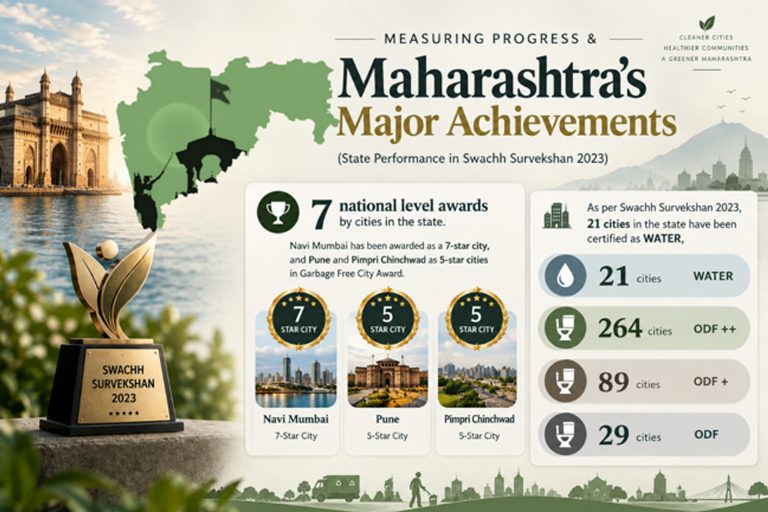
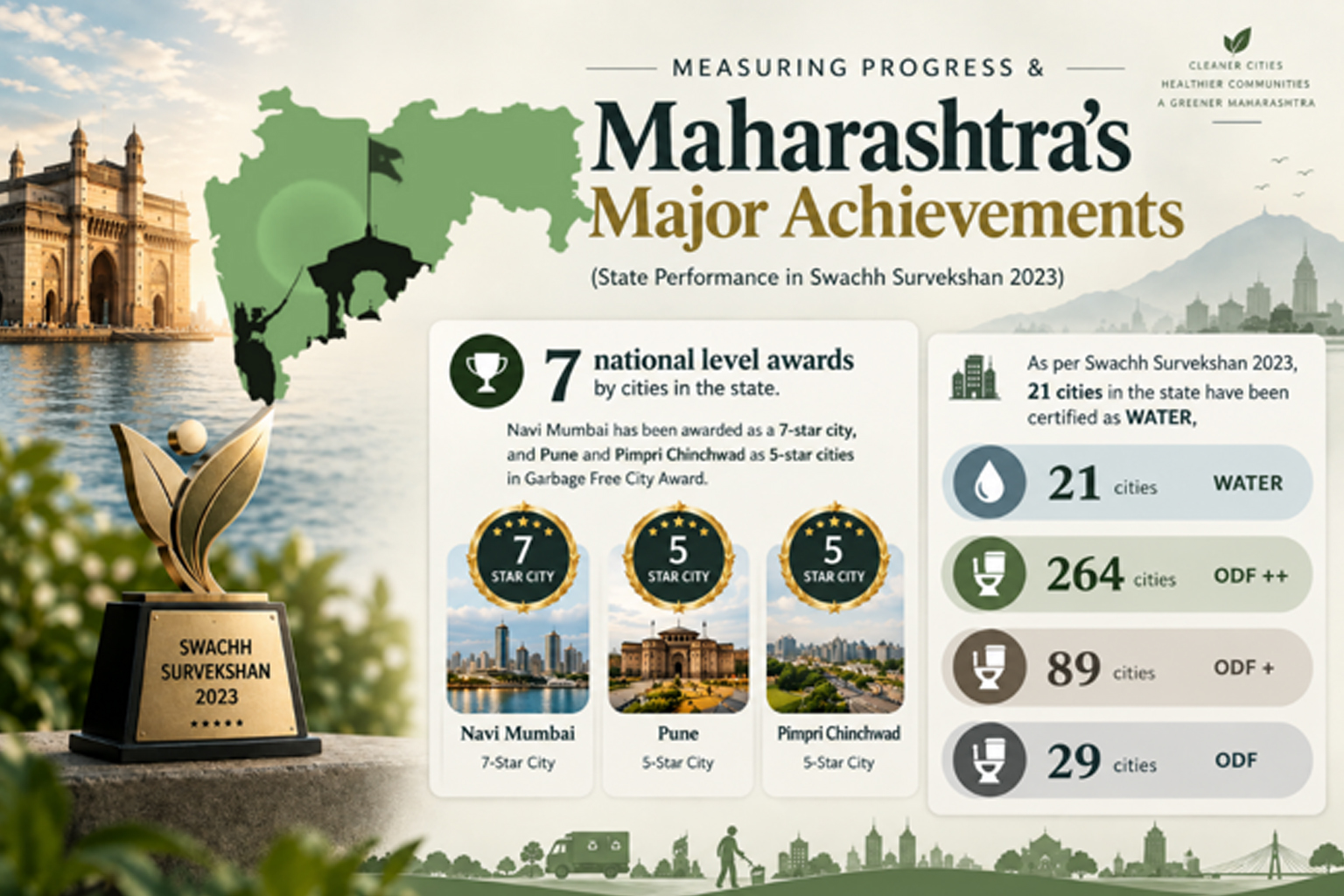
    Measuring Progress & Maharashtra’s Major Achievements (State Performance in Swachh Survekshan 2023)

    1. The state of Maharashtra secured the first position at the national level for the best performing state for the year 2023.
    2. 7 national level awards by cities in the state. Navi Mumbai has been awarded as a 7-star city, Pune and Pimpri Chinchwad as 5-star cities in Garbage Free City Award.
    3. As per Swachh Survekshan 2023, 21 cities in the state have been certified as WATER, 264 cities as ODF + +, 89 cities as ODF + and 29 cities as ODF.


    The Unfinished Challenge

    The completion of the 2021–2026 mission period does not mean that the solid waste challenge has been completely resolved. Waste generation will continue as cities grow. Therefore, the systems established during the mission need to remain functional and improve over time. The continuing priorities include sustaining source segregation along with strengthening decentralised scientific waste processing. The next stage is therefore not simply about creating more infrastructure to manage and process this waste and ensuring the existing infrastructure is used effectively, maintained properly and integrated into a continuous urban waste-management system.

    Looking Beyond 2026

    The five-year period of Swachh Maharashtra Abhiyan (Urban) 2.0 provides an opportunity to examine how Maharashtra can move forward.
    However, the success of these efforts depends not only on government infrastructure but also on active participation from citizens. Source segregation begins at home, and it is one of the most important steps in the entire waste-management chain. When wet, dry and other waste streams are properly separated at the point of generation, they can be directed towards appropriate treatment, recycling and recovery. When waste is mixed at source, its processing and recovery become more difficult, and a larger portion may ultimately be sent for disposal.
    Therefore, achieving sustainable waste management requires a shared responsibility between Urban Local Bodies and citizens. Government can provide the infrastructure and systems, but citizens play a crucial role by segregating waste at source, following collection guidelines, reducing unnecessary waste and supporting recycling and resource recovery practices. The long-term goal is to move from simply managing waste to creating a resource-efficient and circular urban waste-management system.

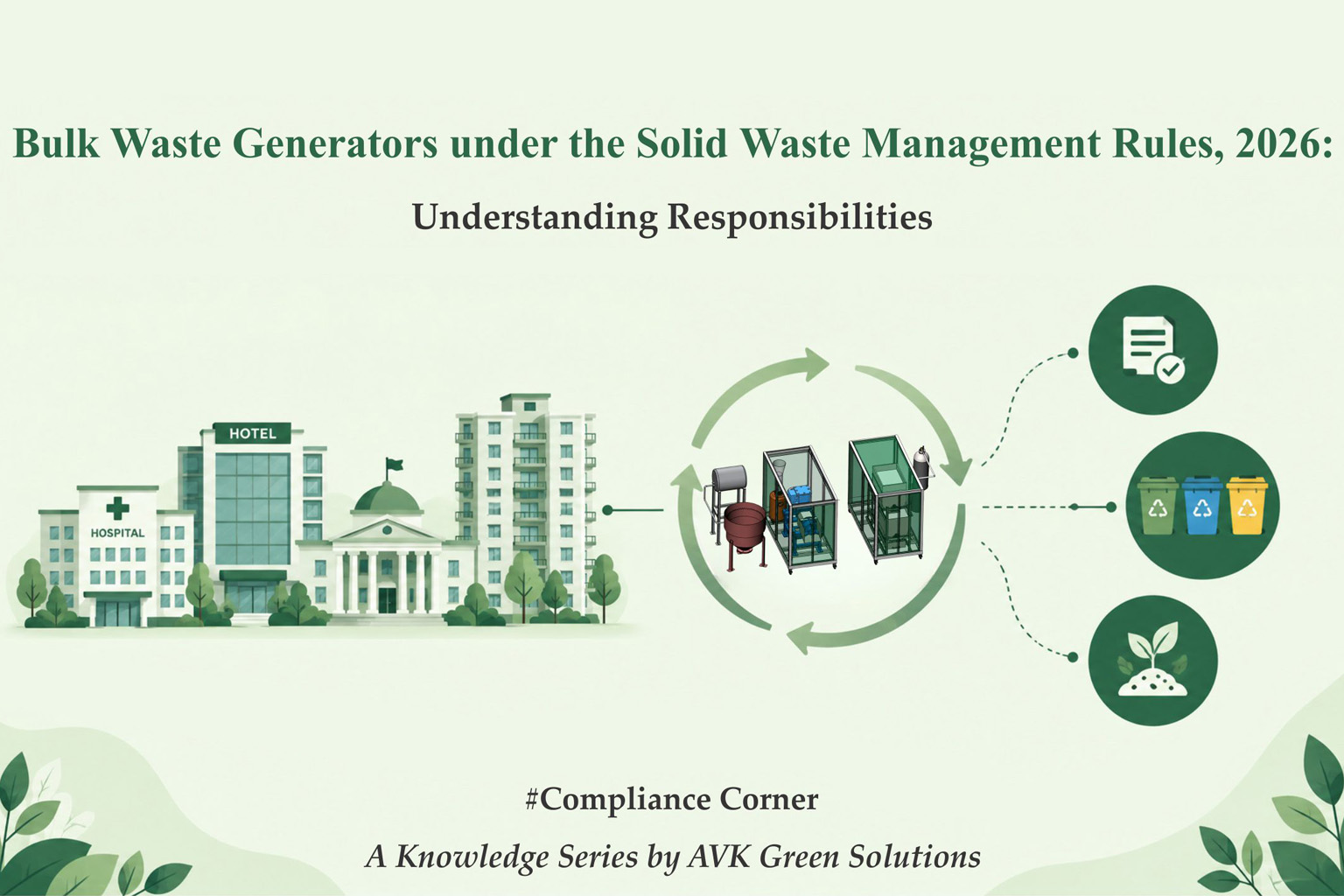
  • Bulk Waste Generators under the Solid Waste Management Rules, 2026

    Bulk Waste Generators under the Solid Waste Management Rules, 2026

    Compliance Corner #2

    Understanding Responsibilities

    Waste management is no longer limited to the collection and disposal of waste. The Solid Waste Management Rules, 2026 place greater responsibility on large waste-generating establishments to ensure that the waste generated by them is properly segregated, processed, collected, transported and scientifically managed.
    One of the important provisions under the Rules is the recognition of Bulk Waste Generators (BWGs) and the introduction of specific responsibilities.
    Understanding who qualify as a BWG—and what they are required to do—is essential for compliance.

    Who is a Bulk Waste Generator?
    Under the Solid Waste Management Rules, 2026, a Bulk Waste Generator covers specified entities that satisfy at least one of the following criteria:

    • Building floor area: 20,000 sq. m. or above
    • Water consumption: 40,000 litres per day or above
    • Solid waste generation: 100 kg per day or above

    This means that an entity does not necessarily need to meet all three criteria. Meeting any one of the prescribed thresholds can bring the entity within the definition of a Bulk Waste Generator, provided it falls under the categories specified in the Rules.

    Which Establishments are covered?

    The Rules broadly cover three major categories of Bulk Waste Generators.
    1. Institutional Users
    These include:

    • Central Government departments and undertakings
    • State Government departments and undertakings
    • Local bodies
    • Public Sector Undertakings and private companies
    • Schools, colleges, universities and other educational institutions
    • Community places and similar establishments

    2. Commercial Users
    The commercial category includes a wide range of establishments such as:

    • Railways, bus stations and depots
    • Airports and ports
    • Hotels and restaurants
    • Hospitals and nursing homes
    • Wholesale markets, including agricultural, horticultural, fish and meat markets
    • Marriage and banquet halls
    • Tourist spots

    3. Residential Societies
    Residential societies are also specifically included within the scope of Bulk Waste Generators when they satisfy at least one of the prescribed thresholds.
    Therefore, BWG compliance is not restricted to commercial establishments. Large residential communities also have an important role to play in implementing decentralized waste management.

    What are the Responsibilities of a Bulk Waste Generator?

    The Rules place several responsibilities on BWGs. These responsibilities go beyond simply handing over waste to a municipal collection vehicle.
    1. Registration with the Local Body
    Every Bulk Waste Generator is required to register with the concerned local body through the centralised online portal.
    The registration certificate will specify the conditions that must be fulfilled for the registration to remain valid.
    If there is any change in the information submitted during registration or in the conditions specified in the registration, the BWG is required to notify the concerned local body.

    2. Proper Handling of Different Waste Streams
    A BWG must make arrangements for the collection and handing over of:

    • Dry waste
    • Sanitary waste
    • Special care waste

    These wastes are to be handed over to the local body or an agency authorised by the local body.
    This establishes an important principle: different categories of waste cannot simply be mixed together and handed over as one waste stream.

    3. Wet Waste Must Be Managed at Source
    One of the key responsibilities under the Solid Waste Management Rules, 2026 is the decentralized management of wet waste and horticulture waste, wherever applicable.
    Bulk Waste Generators (BWGs) are required to make appropriate arrangements for the collection and decentralized processing of wet waste generated at their premises through suitable technologies, includes and these technologies mandated under the Solid Waste Management Rules, 2026:

    • Vermicomposting (Not suitable for large-scale processing due to space requirements.)
    • Biomethanation (Decentralization is difficult at small scale, Compost is not produced)
    • Anaerobic Digestion / Microbial Composting (Perfect solution for decentralization and to obtain nutrient rich organic manure)

    The objective is to ensure that organic waste is processed as close to its point of generation as practicable rather than being transported along with mixed waste for disposal.

    4. New BWGs Must Establish Wet Waste Processing Facilities
    The Rules specifically provide that all new Bulk Waste Generators must set up and operate a wet waste processing facility of adequate capacity.
    The facility must have sufficient capacity to ensure the processing of the complete wet waste generated by the premises, including horticulture waste where applicable.
    This makes decentralized processing an important component of planning for new large residential, institutional and commercial developments.

    5. Provision for Existing BWGs
    The Rules also recognise that some existing Bulk Waste Generators may not be able to establish and operate decentralized wet waste processing facilities.
    In such cases, existing BWGs may obtain an exemption from the local body.
    However, the responsibility does not end with obtaining an exemption.
    Such BWGs are required to procure Extended Bulk Waste Generator Responsibility Certificates from the concerned local body for processing wet waste equivalent to the complete quantity of wet waste generated by them.
    Thus, the Rules create a mechanism through which existing BWGs can fulfil their waste-management responsibility even when on-site processing is not feasible.

    Understanding Extended Bulk Waste Generator Responsibility (EBWGR)

    A major feature of the Solid Waste Management Rules, 2026 is the introduction of Extended Bulk Waste Generator Responsibility.
    Under EBWGR, Bulk Waste Generators are responsible for:

    1. Processing their wet waste and
    2. Ensuring environmentally sound management of dry waste, sanitary waste and special care waste.

    The total EBWGR obligation for the solid waste generated by a BWG will be calculated according to norms issued by the Central Pollution Control Board, in consultation with the concerned ministries and departments.
    This shifts the focus from merely generating and handing over waste to taking responsibility for its environmentally sound management.

    What if a BWG Cannot Process Wet Waste On-Site?
    Where wet waste is not processed by the Bulk Waste Generator itself, the Rules require the BWG to procure Extended Bulk Waste Generator Responsibility Certificates from the local body.

    These certificates relate to the environmentally sound management of waste through collection and transportation and sending the waste to a registered waste processing facility for further processing and treatment.
    This creates an accountability mechanism between the waste generator, local body and registered waste-processing facilities.

    Do Not Engage with Unregistered Waste Entities
    Another important requirement is that a Bulk Waste Generator must not engage with any entity that does not have the registration mandated under the Rules.
    Therefore, BWGs should verify the registration and authorisation status of agencies, waste collectors and processing facilities before handing over waste to them.
    This is particularly important for large establishments that engage private waste-management agencies.

    Annual Reporting and Compliance
    Compliance under the Rules is not limited to registration.

    Every registered Bulk Waste Generator is required to submit an online annual report in the format prescribed by the Central Pollution Control Board.
    The annual return is to be submitted by 30 June every year and must include information relating to the BWG’s Extended Bulk Waste Generator Responsibility obligations, including procurement of EBWGR certificates for the calculated quantity of solid waste generated.
    The annual returns are also to be submitted to the concerned local body for further processing and are to be made available in the public domain on the local body’s website.

    This brings greater transparency to BWG compliance.

    From Waste Generators to Resource Managers

    The Solid Waste Management Rules, 2026 represent an important shift in the way large waste generators are expected to manage waste.
    For a Bulk Waste Generator, compliance is no longer simply about placing waste outside the premises and expecting it to be collected.
    The approach is increasingly based on:
    Generate → Segregate → Process → Recover → Responsibly Manage Residual Waste → Report
    Wet waste can be processed through composting or biomethanation, while dry waste and other waste streams can be directed towards appropriate authorised systems for recovery, treatment or disposal.
    This decentralized approach can reduce the quantity of waste requiring transportation, improve resource recovery and encourage establishments to take greater responsibility for the waste they generate.

    A Compliance Checklist for Bulk Waste Generators

    Every BWG should consider the following questions:

    • Does our establishment meet any of the prescribed BWG thresholds?
    • Have we registered with the concerned local body through the centralised online portal?
    • Are we properly segregating different waste streams?
    • Do we have adequate arrangements for wet waste and horticulture waste processing?
    • If on-site wet waste processing is not feasible, have we obtained the applicable exemption and fulfilled our EBWGR obligation?
    • Are we engaging only with registered/authorised waste-management entities?
    • Are residual waste and inert materials being handed over appropriately?
    • Are we maintaining records required for annual reporting?
    • Have we submitted our annual return by 30 June?
    • Are our EBWGR obligations being fulfilled and documented?
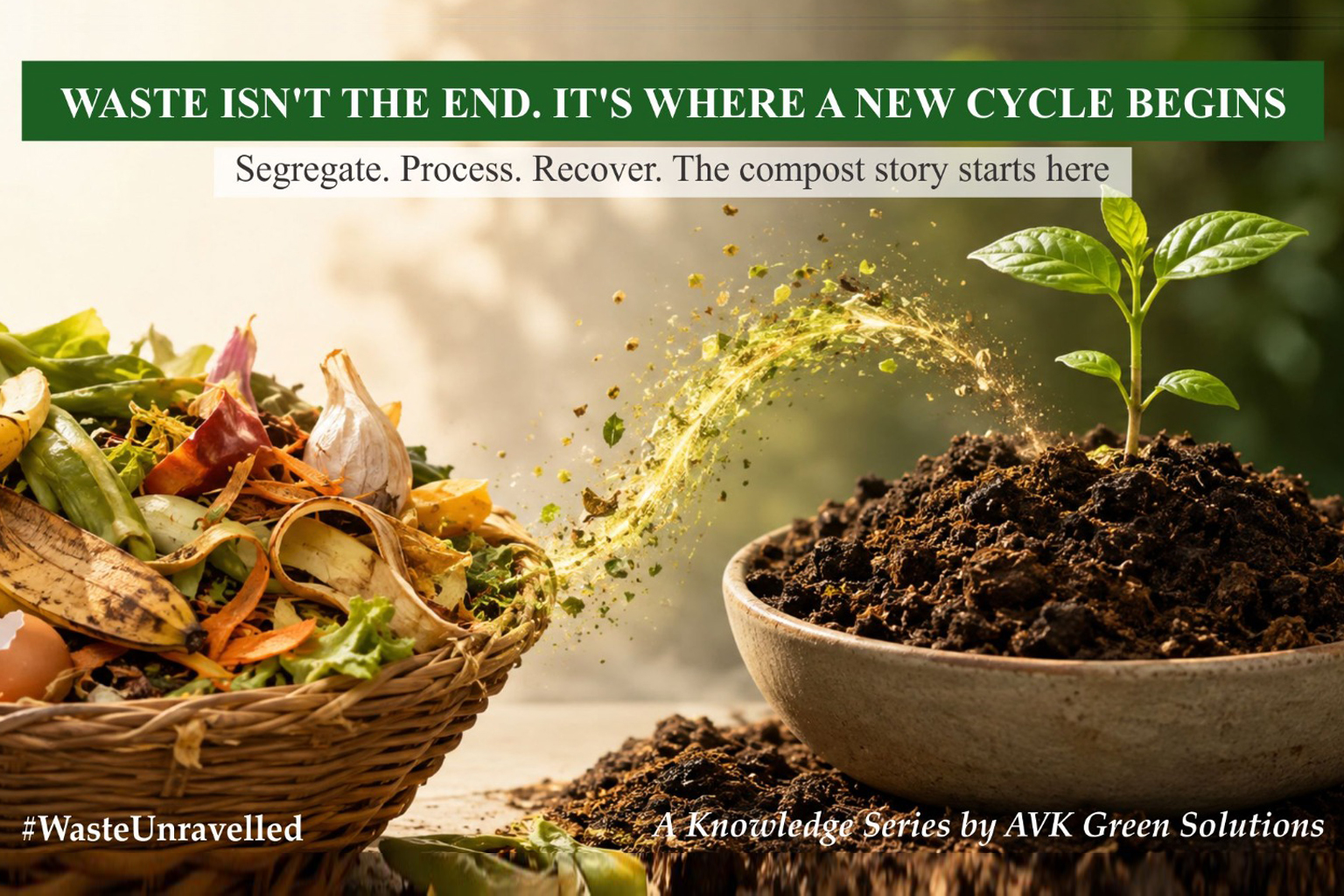
  • Waste Unravelled: What Is Composting?

    Waste Unravelled: What Is Composting?

    Waste Unravelled | Chapter 1

    Waste Unravelled | Chapter #1

    Every day, we throw away vegetable peels, fruit skins, leftover food, flowers and garden waste.

    But is it really waste?

    Organic waste is biodegradable. With the right process, it can be transformed into a useful resource instead of being sent to a landfill.

    This is where composting and biological treatment come in.

    What is composting?

    Composting is a biological process in which microorganisms break down organic matter and convert it into a stable, nutrient-rich organic material.

    In simple terms:

    Organic waste + microorganisms + the right conditions = compost

    The process depends on factors such as moisture, temperature, microbial activity, aeration and the composition of the waste, but composting does not happen in just one way. Different biological technologies can be used depending on the type and quantity of waste, available space and the desired output.

    Three important technologies under SWM Rules 2026

    The Solid Waste Management Rules, 2026 recognise different biological processes for managing biodegradable waste. Three important ones are vermicomposting, anaerobic digestion and bio-methanation.

    1. Vermicomposting

    The Rules define vermicomposting as:

    “The process of conversion of bio-degradable waste into compost using earthworms.”

    In simple terms, earthworms and microorganisms work together to break down biodegradable waste and produce vermicompost.

    Vermicomposting is a natural and valuable method of waste treatment. However, it takes considerable time and requires adequate space for the waste to remain in the system while the biological process takes place.

    For a Bulk Waste Generator producing organic waste every day, this can become a practical challenge.

    1. Anaerobic Digestion

    The Rules define anaerobic digestion as:

    “A controlled process involving microbial decomposition of organic matter in absence of oxygen.”

    Unlike conventional aerobic composting, anaerobic digestion takes place without oxygen.

    The controlled environment allows microorganisms to break down organic matter and can significantly accelerate biological treatment.

    This is the principle behind AVK Green Solutions’ ACCMA™ (Anaerobic Composting by Controlled Microbial Action) technology.

    1. Bio-methanation

    The Rules define bio-methanation as:

    “A process which entails enzymatic decomposition of the organic matter by microbial action to produce methane rich biogas.”

    Bio-methanation uses microbial action to break down organic matter and produce methane-rich biogas.

    It can be an excellent option where there is sufficient waste, space, infrastructure and a practical use for the biogas generated.

    But is it practical for every Bulk Waste Generator?

    Not necessarily.

    Why does the choice of technology matter?

    Consider a typical apartment society.

    It may generate a substantial amount of kitchen and food waste every day, but have limited space available for waste processing.

    The challenge is therefore not simply to find a technology.

    It is to find a technology that is:

    • Fast enough to handle daily waste generation
    • Compact enough for the available space
    • Practical to operate
    • Suitable for decentralised, on-site processing
    • Capable of producing a useful output

    The challenge with vermicomposting

    Vermicomposting is effective, but it is a relatively slow process.

    The waste needs to remain in the system for a significant period before the biological conversion is complete.

    For a Bulk Waste Generator, today’s waste does not replace yesterday’s waste—it is added to it.

    This means the required processing area can quickly increase.

    For smaller apartment communities with limited space, maintaining large vermicomposting areas may therefore not always be practical.

    The challenge with bio-methanation

    Bio-methanation offers the added benefit of generating methane-rich biogas.

    However, it requires appropriate infrastructure, process control and space, along with sufficient feedstock and a practical use for the biogas.

    For smaller residential communities, these requirements may make a conventional bio-methanation system less feasible.

    Where can ACCMA™ help?

    This is where AVK’s ACCMA™ technology offers an alternative.

    Based on anaerobic microbial action, ACCMA™ is designed to accelerate the biological treatment of segregated organic waste.

    AVK machines and plants can process organic waste in as little as 24 hours, depending on feedstock characteristics and operating conditions.

    For Bulk Waste Generators, particularly residential societies with limited space, this can offer a practical way to process wet waste on-site, quickly and with a significantly smaller processing footprint than slower composting methods.

    The objective is simple:

    Generate → Segregate → Process → Recover

    Instead of transporting wet waste away every day, it can be treated closer to where it is generated and converted into a useful organic output.

    But technology starts with segregation

    No composting or biological treatment technology can compensate for poor segregation.

    Plastic wrappers, glass, metal, batteries and other contaminants do not belong with organic waste.

    The journey begins at the source:

    Segregate → Collect → Process → Recover → Reuse

    When organic waste is kept separate, it becomes possible to treat it scientifically and recover its value.

    So, which technology is right for you?

    There is no single technology that works for every situation.

    Vermicomposting can work well where adequate space and time are available.

    Bio-methanation can be highly useful where sufficient waste, infrastructure and a use for biogas make the system viable.

    Anaerobic digestion-based technologies such as ACCMA™ can provide a practical option for Bulk Waste Generators looking for rapid, decentralised and space-efficient organic-waste processing.

    The right solution depends on the quantity of waste, available space, operational requirements and desired outcome.

    Waste Unravelled

    Composting is not simply about letting waste decompose.

    It is about using biology and technology to transform something we call “waste” into something useful.

    As the SWM Rules, 2026 place greater emphasis on segregation and responsible processing of wet waste, the question for Bulk Waste Generators is no longer simply:

    “Where do we send our wet waste?”

    It is:

    “How can we process it responsibly, efficiently and as close to the source as possible?”

    Because waste doesn’t have to be the end of the cycle.

    It can be the beginning of another one.

    AVK Green Solutions

    Transforming waste into environmental health and wealth.

    About Waste Unravelled

    Waste Unravelled is a series by AVK Green Solutions that breaks down the world of waste management—one concept at a time.

    From composting and segregation to recycling, processing technologies and what really happens to our waste after it leaves our homes, this series aims to make waste management simple, understandable and relevant to everyday life.

    Because understanding waste is the first step towards managing it better.

    Waste Unravelled — making sense of the waste around us.

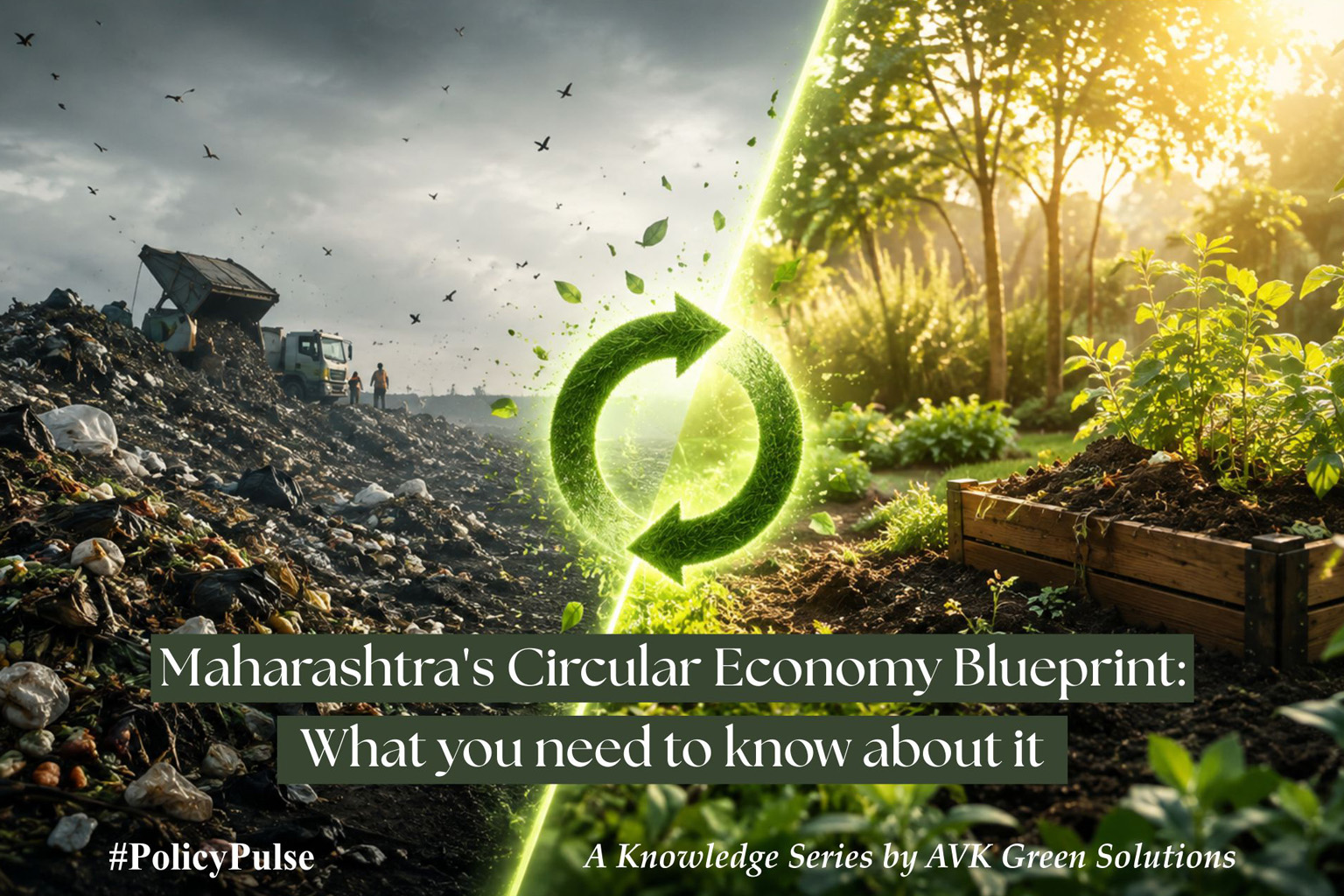
  • Maharashtra Circular Economy Policy 2026: What It Means for Waste Management

    Maharashtra Circular Economy Policy 2026: What It Means for Waste Management

    Maharashtra is drafting a new circular economy policy to boost recycling, cut pollution, and modernize waste management across Mumbai, Pune and 430 urban local bodies. Here’s what’s inside it.

    Maharashtra’s New Circular Economy Policy: A Roadmap to Turn Waste into Opportunity

    Maharashtra is preparing to table a landmark circular economy policy before the state cabinet, a move aimed at strengthening the recycling industry, curbing pollution and addressing the state’s escalating waste management challenges. The draft policy targets electronic, municipal, solid and plastic waste streams, positioning Maharashtra as a frontrunner in India’s shift toward sustainable resource management.

    For sectors like solid waste management (SWM), sustainability consulting and green infrastructure, this policy signals a major shift in how urban local bodies (ULBs), industries and recyclers will operate in the years ahead.

    Why Maharashtra Needs a Circular Economy Policy Now?

    India generates around 62 million tonnes of waste annually, and the pressure on landfills, municipal systems and industrial recyclers is only intensifying. According to industry estimates cited in the policy discussions, the global circular economy could reach a market size of $2 million by 2050, with the potential to create 10 million jobs, alongside a Rs 10.8 lakh crore investment opportunity in India. Projections also suggest a circular economy could cut greenhouse gas emissions by 39 per cent by 2050, even as annual waste generation is expected to rise 70 per cent over the same period.

    These numbers make one thing clear: waste management can no longer be treated as an afterthought. It must become a system that creates economic value through resource recovery, recycling, composting and local employment.

    What the Draft Policy on Circular Economy Aims to Do?

    The draft policy is designed to move the state away from a Linear Economy model

    Traditional Linear Economy:

    • Take → Make → Use → Dispose

    and move toward

    Circular Economy:

    • Reduce → Reuse → Recycle → Recover → Regenerate

    Key Pillars of the Policy

    • Fiscal and non-fiscal incentives
    • Ease-of-doing-business reforms
    • Dedicated waste recycling parks
    • Revenue generation for municipalities

    The Problem the Policy Is Trying to Solve

    Mumbai’s Legacy Landfill Crisis

    The policy’s urgency becomes clear when you look at sites like Govandi in Mumbai. The Brihanmumbai Municipal Corporation has acknowledged the scale of the challenge in managing waste generated by the city’s 15 million residents plus its large floating population.

    The Numbers Across Maharashtra

    Maharashtra’s waste management gap is significant at scale:

    • 430 urban local bodies across the state generated 24,297 metric tonnes of waste daily in 2025, of which around 82 per cent (19,847 MT) is treated.
    • Mumbai alone produces roughly 7,000 metric tonnes of dry and wet waste daily, spanning food and organic matter, wood, textiles, construction debris, plastics, paper, and recyclable metals
    • Segregation at source remains poor despite a 5 per cent property tax rebate offered to housing societies that comply.
    • Pune generates about 2,800 MT of waste daily, with its Urali Devachi landfill facing environmental concerns and recurring local protests; a 500 MT mixed waste processing plant has since been set up there, alongside biomining of roughly 5.3 million MT of legacy waste.

    Why This Matters for Waste Management Stakeholders?

    For ULBs, recyclers, and sustainability-focused enterprises, this draft policy could reshape how compliance, infrastructure investment, and municipal partnerships work going forward. A policy environment that rewards scientific waste processing and penalizes legacy dumping creates real incentives for organizations already investing in decentralized composting and resource recovery waste solutions particularly as India’s regulatory landscape around solid waste management continues to tighten.

    AVK: Enabling Maharashtra’s Waste Economy

    AVK Green Solutions aligns closely with the emerging waste economy by moving beyond the traditional approach of collect, transport, and dispose. Our ACCMA™ technology enables waste to be processed where it is generated, converting organic waste from a recurring disposal cost into a usable resource.

    This is the fundamental shift a circular waste economy requires: waste should remain within the economy for as long as possible, rather than being transported to a landfill and lost.

    By processing Kitchen, Horticultural, Marketyard, Agro and Water Hyacinth waste at source, AVK helps reduce dependence on waste transportation and landfill infrastructure while creating a continuous local cycle of waste → processing → organic manure → soil → food and green spaces.

    The economic value extends beyond the manure itself. Decentralised processing can reduce collection and transportation costs, lower the burden on municipal infrastructure, reduce landfill dependence and create opportunities for local operation, maintenance, landscaping and resource recovery services.

    For Maharashtra’s cities, this model is particularly relevant as urbanisation continues to increase waste generation. Instead of continually expanding the infrastructure required to move and dispose of waste, decentralised technologies such as AVK can help create a network of distributed resource-recovery centres across residential communities, institutions, hospitals, commercial establishments, industrial parks and local bodies.

    In this sense, AVK is not simply solving the problem of where waste goes. It is helping answer a more important question:

    How can the waste we generate become part of the economy again?

    • That is where AVK’s model fits naturally into Maharashtra’s waste economy — turning organic waste into a resource, reducing recurring costs, creating local value, and making circularity practical at the point of generation.

    Take Action Today

    • Maharashtra has established the legal framework, capital incentives and enforcement mechanisms. The technology is proven, scalable and ready for deployment.
    • Partner with AVK Green Solutions to make your facility 100% compliant, zero-waste and environmentally resilient.
    • Contact AVK Green Solutions today to request a site audit and tailored waste management strategy. We will quantify your organic waste stream, recommend the right AVK system for your scale and guide your government subsidy application — turning compliance into a daily sustainability asset.

    About Policy Pulse

    Policy Pulse is a knowledge series by AVK Green Solutions, breaking down the policies shaping India’s waste and environmental landscape. We simplify what’s changing, why it matters, and what it means for communities, businesses, and institutions.

  • Compliance Corner

    Compliance Corner #1

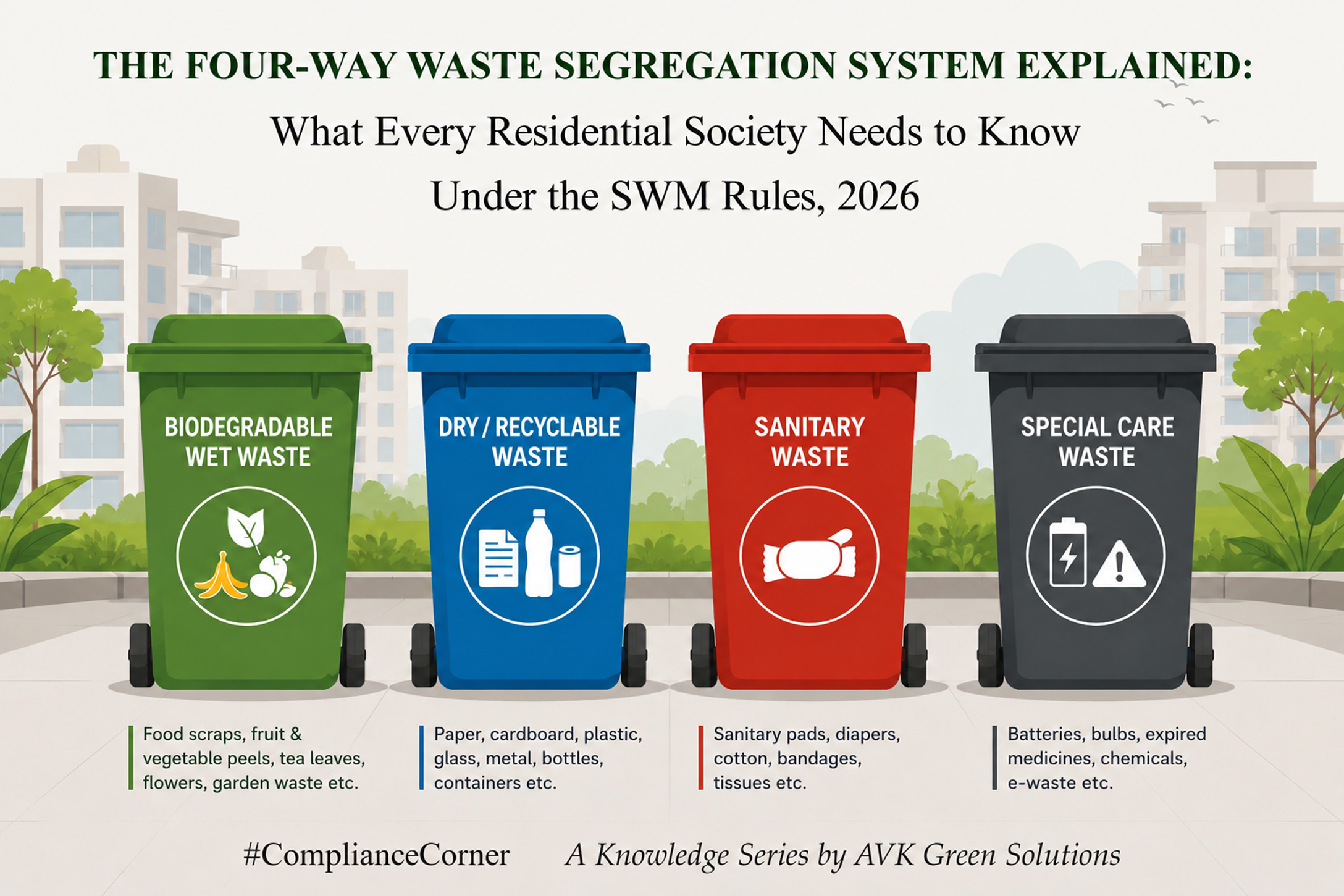
    The Four-Way Waste Segregation System Explained: What Every Residential Society Needs to Know Under the SWM Rules, 2026

    “Compliance begins with segregation. Without it, no waste management system can be successful.

    Imagine preparing a traditional Indian thali by serving dal, rice, pickle, dessert, and curd all mixed together in one bowl. While the ingredients may be the same, combining them destroys their individual taste, texture, and purpose.

    Waste is no different.

    Every type of waste has a different destination. Kitchen waste can be converted into compost, recyclable materials can be recovered, sanitary waste requires safe handling, and hazardous waste needs specialised disposal. When everything is mixed together, valuable resources are lost and the entire waste management system becomes less effective.

    Recognising this, the Solid Waste Management Rules, 2026 place greater emphasis on four-way segregation at source, ensuring that each type of waste can be managed in the most appropriate and sustainable way.

    What is Four-Way Waste Segregation?

    The SWM Rules, 2026 require waste to be separated into four distinct categories before it leaves your home.

    Biodegradable (Wet) Waste

    This is organic waste that naturally decomposes and can be converted into compost.

    Examples include:

    • Fruit and vegetable peels
    • Leftover food
    • Tea leaves and coffee grounds
    • Eggshells
    • Garden waste
    • Flowers and leaves

    Recommended bin: Green

    Dry Waste (Recyclables)

    These materials can be recovered and recycled when kept clean and dry.

    Examples include:

    • Paper and cardboard
    • Plastic bottles and containers
    • Glass bottles
    • Metal cans
    • Cartons
    • Clean packaging material

    Recommended bin: Blue

    Sanitary Waste

    Sanitary waste requires careful handling to protect waste collectors and prevent contamination.

    Examples include:

    • Used diapers
    • Sanitary pads
    • Tampons
    • Bandages
    • Cotton swabs
    • Disposable tissues contaminated with bodily fluids

    These items should be securely wrapped before disposal.

    Recommended bin: Red (or as prescribed by your local authority)

    Special Care (Domestic Hazardous) Waste

    Although generated in smaller quantities, these materials require separate collection because they can harm people or the environment.

    Examples include:

    • Batteries
    • CFLs and tube lights
    • Paint containers
    • Expired medicines
    • Aerosol cans
    • E-waste
    • Chemical containers

    Never mix these with household waste.

    Why Four-Way Segregation Matters

    Segregation is more than a compliance requirement,it is the foundation of an efficient waste management system.

    When waste is segregated:

    • Organic waste can be processed into compost.
    • Recyclable materials retain their value and are easier to recover.
    • Hazardous materials are handled safely.
    • The volume of waste sent to landfills is significantly reduced.
    • Municipal waste collection becomes more efficient.

    What This Means for Residential Societies

    For residential societies, implementing four-way segregation is often the first and most important step toward compliance with the SWM Rules, 2026.

    Success depends on:

    • Clearly labelled bins throughout the premises.
    • Resident awareness and participation.
    • Regular training for housekeeping staff.
    • Periodic monitoring and feedback.

    Compliance is not achieved by installing more bins alone,it requires consistent participation from every household.

    Compliance Tip of the Week

    Walk through your society today and ask one simple question: Are residents truly segregating waste into four categories before handing it over?

    If the answer is no, now is the right time to start. Every correctly segregated bag of waste brings your community one step closer to compliance and contributes to a cleaner, healthier, and more sustainable neighbourhood.

    About Compliance Corner

    Compliance Corner is a knowledge series by AVK Green Solutions, simplifying the Solid Waste Management Rules, 2026 into practical guidance for residential societies, facility managers, businesses, and institutions. Our goal is to help communities understand the “why” behind the rules and take informed steps toward sustainable waste management.

Contact us

    For technical queries please call +91 9371025960

    Office Address: Second & Third Floor, Pinnac House – II, Pinnac Memories, S. No. 7/4, S. No. 8/4 to 8, Kothrud, Pune – 411038

    Contact us

      Office Address: Second & Third Floor, Pinnac House – II, Pinnac Memories, S. No. 7/4, S. No. 8/4 to 8, Kothrud, Pune – 411038

      Contact us

        Office Address: Second & Third Floor, Pinnac House – II, Pinnac Memories, S. No. 7/4, S. No. 8/4 to 8, Kothrud, Pune – 411038

        Contact us

          Office Address: Second & Third Floor, Pinnac House – II, Pinnac Memories, S. No. 7/4, S. No. 8/4 to 8, Kothrud, Pune – 411038

          Contact us

            Office Address: Second & Third Floor, Pinnac House – II, Pinnac Memories, S. No. 7/4, S. No. 8/4 to 8, Kothrud, Pune – 411038

            Contact us

              Office Address: Second & Third Floor, Pinnac House – II, Pinnac Memories, S. No. 7/4, S. No. 8/4 to 8, Kothrud, Pune – 411038

              Contact us

                Office Address: Second & Third Floor, Pinnac House – II, Pinnac Memories, S. No. 7/4, S. No. 8/4 to 8, Kothrud, Pune – 411038