Swachh Maharashtra Abhiyan (Urban) 2.0
From Mission to Impact - A Five-Year Journey Towards
‘Garbage-Free Cities’
“Empowering Communities with a unified Vision: One Mission towards Garbage-Free Cities”
Urbanisation has brought rapid growth to Maharashtra’s cities, but it has also increased the generation of solid waste, wastewater and sanitation-related challenges. Managing these challenges requires more than collection and disposal—it requires scientific treatment, resource recovery, sustainable sanitation infrastructure and active participation from citizens. With this objective, the Swachh Maharashtra Abhiyan (Urban) 2.0 was implemented for the period 2021–2026, with a focus on strengthening urban sanitation and waste-management systems across the state. The mission aimed to move cities towards cleaner and more sustainable urban environments through improved waste management, sanitation, used-water management, behaviour change and institutional capacity building.
As the mission period comes to an end, it is important to look beyond the targets and examine what was implemented, what changed and what lessons can guide the next phase of urban waste and sanitation management in Maharashtra.
From Waste Collection to Resource Recovery
Every day, cities generate large quantities of municipal solid waste—from households, markets, commercial establishments, institutions and public spaces. But the challenge does not end with collecting this waste. What happens after the waste leaves our homes is equally important…
When wet waste, dry waste, sanitary waste and other waste streams are mixed at the point of generation, the entire waste-management chain becomes more difficult. Materials that could otherwise be composted, recycled or recovered become contaminated. The mixed waste then requires additional handling and processing, and a portion may ultimately move towards disposal.This is where the fundamental principle of scientific solid waste management becomes important: “Segregation is not the end of waste management. It is the beginning.”
The challenge, therefore, is not simply to collect more waste. It is to ensure that waste is segregated, collected separately, processed scientifically and recovered wherever possible.This principle was central to the vision of ‘Swachh Maharashtra Abhiyan (Urban) 2.0’.
Swachh Maharashtra Abhiyan (Urban) 2.0
(Duration - 2021 to 2026)
The guidelines for implementing “Swachh Bharat Mission (Urban) 2.0” as a mission in the country have been issued by the Ministry of Housing and Urban Affairs, Government of India. It was released on 25 October 2021. According to this, the mission must be implemented in all legally established urban local bodies in the country. In line with this, a campaign “Swachh Maharashtra Abhiyan (Urban) 2.0” has been approved to be implemented in the state.
Core objectives:
- Garbage-Free Cities: Make all urban cities completely garbage-free.
- Sustainable Solid Waste Management: Going beyond just waste collection to achieve 100% source segregation (wet, dry, sanitary and hazardous waste) and complete scientific processing, door-to-door waste collection, and scientific processing of solid and liquid waste.
- 3R Principles: Implement Reduce, Reuse, and Recycle mechanisms across all municipal bodies.
- Dumpsite Remediation: Clean up and remediate legacy waste dumpsites.
About the campaign:
In order to achieve the ultimate goal of a “Garbage Free” Urban India, the implementation of the components of the “Swachh Maharashtra Mission (Urban) 2.0” has been supplemented by the experience of the earlier “Swachh Bharat Mission” as well as by the Ministry of Housing and Urban Affairs, Government of India. The Operational Guidelines issued on 25th October, 2021 are being relied upon. Accordingly, under the “Swachh Maharashtra Abhiyan (Urban) 2.0,” a vision to achieve “Garbage Free City” status for all cities has been envisaged with a target to achieve the Sustainable Solid Waste Management.
What Does a Garbage-Free City Really Mean?
A garbage-free city is not simply a city where waste is collected regularly or where streets and public spaces appear clean. It requires a system in which waste is segregated at source, collected separately, scientifically processed, and recovered wherever possible, with minimal dependence on disposal.
India generates about 1,70,000 tonnes (1.7 lakh tonnes) of municipal solid waste every day and nearly 40% not formally processed, according to recent reports by the Central Pollution Control Board (CPCB).As these quantities increase with urbanisation, cities need systems that can manage waste throughout its entire lifecycle.
When waste is mixed at source, recyclable and biodegradable materials can become contaminated, reducing their recovery potential and making subsequent processing more difficult. Therefore, achieving cleaner and more sustainable cities requires a shift from “collect and dispose” to “segregate, process and recover.” This systemic shift formed an important part of the approach under Swachh Maharashtra Abhiyan (Urban) 2.0.
Why Sustainable Solid Waste Management Matters for Maharashtra:
For a rapidly urbanising state like Maharashtra, solid waste management is a continuous urban challenge. ‘Maharashtra’ is India’s largest waste creator. Maharashtra generates 15% of India’s trash, with the state contributing 21,867 tonnes per day and 68% waste is not getting treated.
According to Central Pollution Control Board (CPCB), the treatment is currently inadequate for Maharashtra. There are several locations where waste is being dumped in the open. Meanwhile, Mumbai, which has about 10% of the state’s pollution, produces 44% of the state’s trash. In cities such as Mumbai, there is no substantial processing at source or at dumping grounds. This waste is generated every day by households, commercial establishments, institutions, markets and other urban activities. If this waste is not properly segregated, collected, processed and disposed of, it can create multiple environmental and urban-management problems.
Traditional waste management has often followed a linear pattern:
Generate → Collect → Transport → Dump
Such a system places significant pressure on land available for disposal and does not fully utilise the resources present in waste. When waste is dumped without adequate scientific treatment or containment, it can lead to foul odour, air and water pollution, pest and vector breeding, and the generation of leachate that can contaminate surrounding soil and water sources.
A sustainable approach requires a different chain:
Generate → Segregate → Collect → Process → Recover → Reuse
This shift forms the foundation of scientific solid waste management. It represents a fundamental change in how cities approach solid waste management—from simply moving waste away to managing it as a resource. Segregation enables better processing, processing enables resource recovery, and recovery creates opportunities for reuse and recycling.
What is Sustainable Solid Waste Management as per Swachh Maharashtra Abhiyan (Urban) 2.0?
The objective of this component is to make all cities clean and garbage free by 100 per cent scientific treatment of city solid waste. It includes the following items:
1. To ensure cleanliness and hygiene of public places and to make all cities clean and garbage free with 100 per cent standardized solid waste management practices.
2. Reducing air pollution during solid waste management.
3. Reducing the use of single-use plastics. The following entities will be eligible to receive funds under this: –
- MRFs, waste transfer stations, compost plants, processing facilities, plastic waste processing facilities. Establishing waste treatment facilities such as waste-to-energy plants, sanitary landfills, etc.
- Factors include procuring mechanical sweeping machine equipment and setting up processing facilities for effective management of construction and demolition waste.
- Biomining / capping of legacy waste sites in all cities
Current situation:
Solid Waste Management Out of the solid waste generated in the urban local bodies of the state, a total of 22503 MT (Metric Tonne) / day is being processed in India. It is producing 1200 MT of compost every day. A total of 230 local bodies have been awarded the “Green City Compost brand”.
A Shift towards Sustainable Urban Waste Management:
The objective of this component is to make all cities clean and garbage free by 100 percent scientific treatment of city solid waste. It includes the following items:
To ensure cleanliness and hygiene of public places and to make all cities clean and garbage free with 100 per cent standardized solid waste management practices. Reducing air pollution during solid waste management. Reducing the use of single-use plastics.
Changes in information education dissemination and public awareness / citizen engagement:
The Objective: The objective of these components is to intensify the mass movement to achieve the goal of “Garbage Free” cities and to ensure awareness generation by reaching out to the citizens at large to institutionalize clean behaviour and related actions and to ensure awareness generation by reaching out to the citizens at large to intensify the mass movement and institutionalize clean behaviour and related actions to achieve the goal of “Garbage Free” cities. Under this, Indian Swachhata League 1.0 and 2.0, Swachhata Pledge, Swachhotsav, Swachhata Yatra, Swachhata Hi Seva, Safaimitra Suraksha Shivir, etc. campaigns have been undertaken.
The Solid Waste Management Approach under SBM-U 2.0
Under Swachh Maharashtra Abhiyan (Urban) 2.0, the focus on solid waste management was not limited to waste collection. It involved strengthening the complete waste-management system.
The approach included:
- Source segregation of waste
- Scientific collection and transportation
- Waste-processing infrastructure
- Organic waste processing and composting
- Material recovery and recycling
- Legacy waste processing and biomining
- Reduction of waste going to dumpsites
- Resource recovery from waste
The objective was to ensure that waste generated within urban areas is increasingly treated as a material that can be processed and recovered, rather than simply transported to a disposal site.
From Targets to Action: What Was Implemented?
The implementation of sustainable solid waste management involved interventions at different stages of the waste-management chain.
- Source Segregation: Starting at the Point of Generation
The effectiveness of any waste-management system begins with segregation at source. Separating waste according to its characteristics allows different waste streams to be treated through appropriate processes. Organic waste, recyclable material and residual waste can follow different treatment and recovery pathways. Thus, segregation is not merely a cleanliness activity; it is the first step towards resource recovery. - Scientific Waste Processing
A major focus was strengthening the capacity of Urban Local Bodies to process municipal solid waste scientifically. Waste-processing infrastructure enables collected waste to move beyond simple disposal and towards treatment and recovery. For biodegradable waste, processing can include methods such as composting, allowing organic material to be converted into a useful product rather than remaining part of a mixed waste stream.
This creates an important shift:
Organic waste → Processing → Compost → Resource
Instead of:
Organic waste → Dumping → Long-term accumulation - Composting and Resource Recovery
Organic waste forms an important component of municipal solid waste. Processing this fraction provides an opportunity to recover value from material that would otherwise contribute to waste accumulation. Composting converts biodegradable waste into a useful resource that can support soil and agricultural applications. The emphasis on compost production therefore represents more than waste reduction. It reflects a broader transition towards resource recovery and circularity in urban waste management.
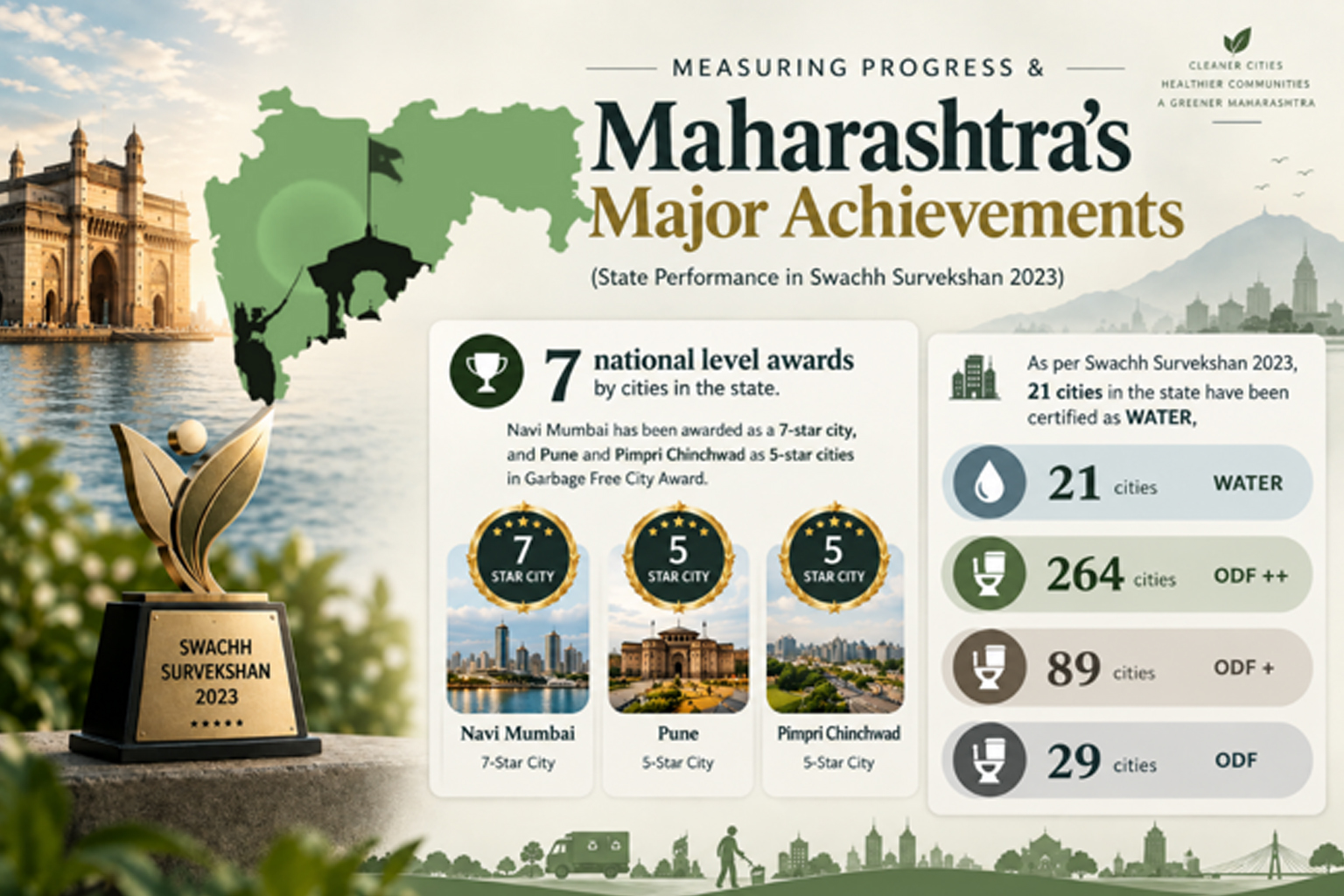
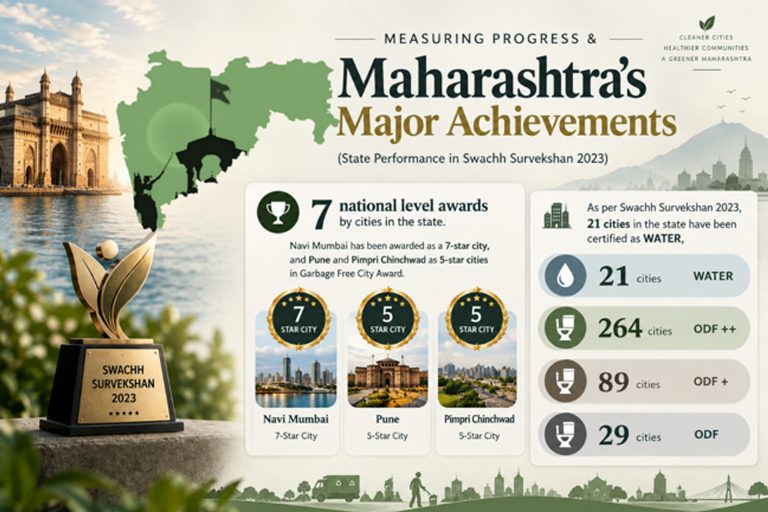
Measuring Progress & Maharashtra’s Major Achievements (State Performance in Swachh Survekshan 2023)
- The state of Maharashtra secured the first position at the national level for the best performing state for the year 2023.
- 7 national level awards by cities in the state. Navi Mumbai has been awarded as a 7-star city, Pune and Pimpri Chinchwad as 5-star cities in Garbage Free City Award.
- As per Swachh Survekshan 2023, 21 cities in the state have been certified as WATER, 264 cities as ODF + +, 89 cities as ODF + and 29 cities as ODF.
The Unfinished Challenge
The completion of the 2021–2026 mission period does not mean that the solid waste challenge has been completely resolved. Waste generation will continue as cities grow. Therefore, the systems established during the mission need to remain functional and improve over time. The continuing priorities include sustaining source segregation along with strengthening decentralised scientific waste processing. The next stage is therefore not simply about creating more infrastructure to manage and process this waste and ensuring the existing infrastructure is used effectively, maintained properly and integrated into a continuous urban waste-management system.
Looking Beyond 2026
The five-year period of Swachh Maharashtra Abhiyan (Urban) 2.0 provides an opportunity to examine how Maharashtra can move forward.
However, the success of these efforts depends not only on government infrastructure but also on active participation from citizens. Source segregation begins at home, and it is one of the most important steps in the entire waste-management chain. When wet, dry and other waste streams are properly separated at the point of generation, they can be directed towards appropriate treatment, recycling and recovery. When waste is mixed at source, its processing and recovery become more difficult, and a larger portion may ultimately be sent for disposal.
Therefore, achieving sustainable waste management requires a shared responsibility between Urban Local Bodies and citizens. Government can provide the infrastructure and systems, but citizens play a crucial role by segregating waste at source, following collection guidelines, reducing unnecessary waste and supporting recycling and resource recovery practices. The long-term goal is to move from simply managing waste to creating a resource-efficient and circular urban waste-management system.