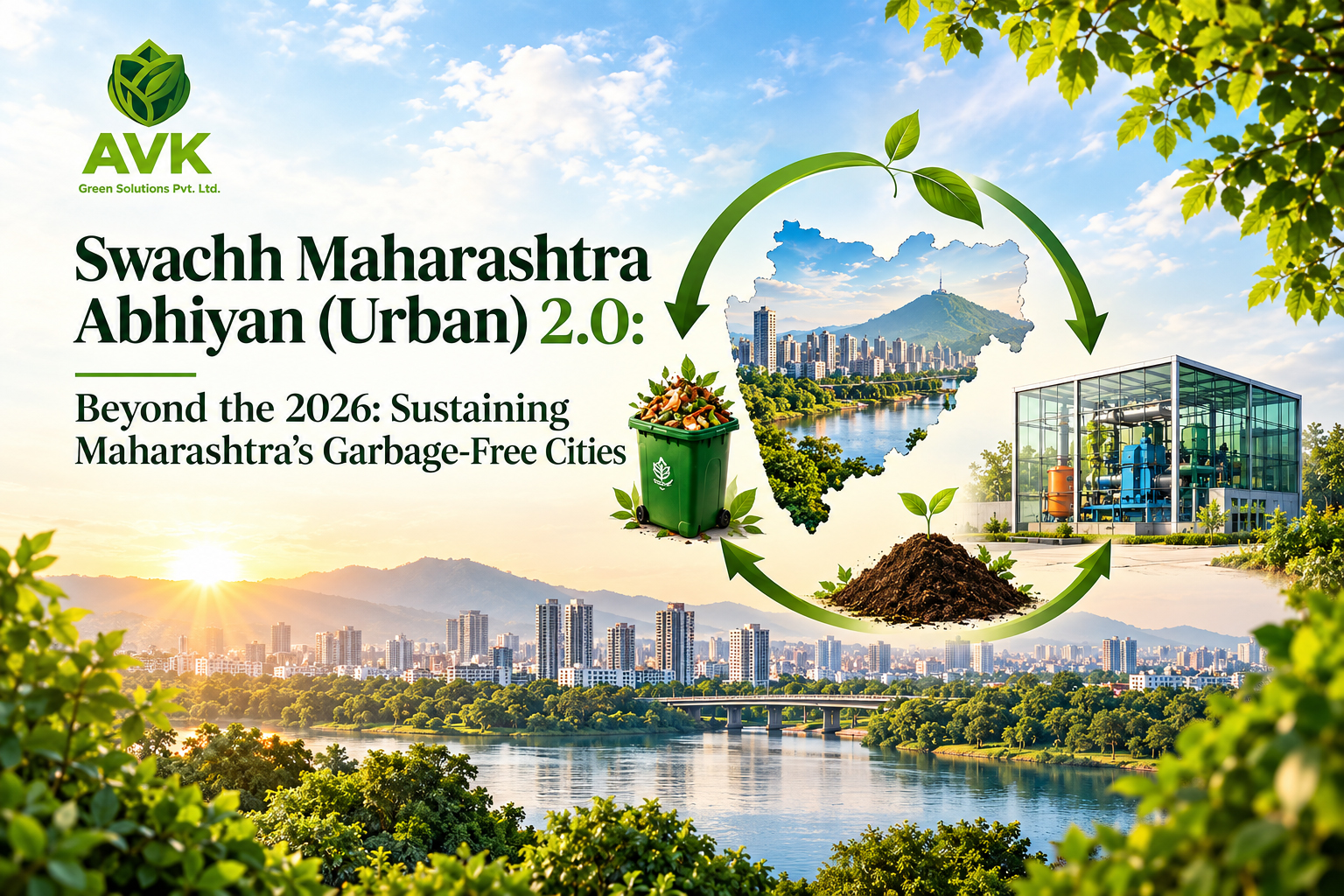
Swachh Maharashtra Abhiyan (Urban) 2.0
Beyond the Mission: Sustaining Maharashtra’s Garbage-Free Cities
The journey towards Garbage-Free Cities does not end with the completion of a mission period. The real measure of success lies in our ability to sustain the progress achieved and make cleanliness a permanent part of urban life. Over the past five years, Maharashtra’s cities have taken significant steps towards improving waste management, strengthening systems, encouraging source segregation and involving citizens in Swachhata initiatives. As we look beyond 2026, the challenge is no longer simply to achieve the status of a Garbage-Free City, but to ensure that this status is maintained year after year.
This raises an important question: How do we sustain the progress achieved between 2021 and 2026? Infrastructure and systems can be established by governments, but their long-term success depends on consistent implementation and public participation. If citizens stop segregating waste, illegal dumping begins again, or communities lose interest in cleanliness initiatives, the progress made over the years can quickly come under pressure. Therefore, while the Mission may conclude in 2026, the collective responsibility to maintain a Garbage-Free City must become an ongoing—because ‘The mission ends, but the commitment continues.’
From Government Mission to People’s Movement
A clean city cannot be created by government efforts alone. While municipal bodies are responsible for providing infrastructure, collection systems, processing facilities and services, the success of the entire waste-management system begins at the household level. Every resident has a role to play in determining what happens to the waste generated every day.
The next phase of Maharashtra’s Swachhata journey must therefore move from a government-led programme towards a people-led movement. Resident welfare associations, schools, colleges, NGOs, corporate organisations, community groups and local citizens can become active partners in maintaining cleanliness. Source segregation, responsible disposal and participation in community initiatives should not be viewed as occasional activities linked to a campaign or competition. They need to become everyday habits. True transformation begins when Swachhata becomes a shared responsibility rather than someone else’s duty—because a ‘Clean Maharashtra begins with every citizen.’
What Happens After the Mission Ends?
The progress achieved over the past five years cannot be taken for granted. If momentum is lost, cities may once again face challenges that they have worked hard to overcome. Uncontrolled dumping can return to roadsides, open spaces and water bodies. Increasing quantities of waste can put additional pressure on landfills and waste-processing facilities. Rivers, lakes and other water bodies can become vulnerable to pollution, while poor waste management can also create public-health and environmental concerns.
The lesson is clear: Maintaining Progress Requires Continuous Action. A clean street today does not guarantee a clean street tomorrow. A successfully processed waste stream today does not guarantee responsible waste management in the future. Continuous monitoring, citizen participation, efficient systems and responsible behaviour are essential to prevent cities from slipping backwards.
Therefore, sustaining Maharashtra’s Swachhata achievements requires continued commitment to protect the progress made and build upon it—because ‘Preserving progress today is the foundation for greater progress tomorrow.’
The Next Five Years: Maharashtra’s Roadmap to Zero-Waste Cities
Looking ahead, Maharashtra has an opportunity to move beyond the conventional approach of simply collecting and disposing of waste. The future lies in creating cities where waste is reduced, reused, recycled, recovered and treated as a resource rather than something destined for disposal.
This transition requires greater emphasis on the principles of the circular economy, where materials remain in use for as long as possible and the generation of waste is minimised. Decentralised waste-processing systems, composting, biogas generation, recycling, resource recovery and scientific management of different waste streams can help cities reduce their dependence on landfills.
The next five years can therefore be about moving from waste management to resource management—creating urban systems that are cleaner, more efficient and more sustainable. A zero-waste city may be an ambitious goal, but every reduction in waste generation, every tonne diverted from landfill and every material recovered represents a step towards that vision.
The Future of Waste: From Garbage to Resource
For decades, waste has largely been viewed as something that needs to be collected and removed. But the future demands a different perspective. What we call “waste” often contains materials that still have value. Organic waste can become compost or biogas. Dry recyclable waste can enter recycling chains and return to the economy as useful material. Construction and demolition waste can be processed and reused in appropriate applications.
This shift in perspective can also create new opportunities for livelihoods, entrepreneurship and local economic activity. Waste-processing facilities, recycling enterprises, composting units, resource-recovery systems and other circular-economy solutions can contribute to both environmental sustainability and economic development.
The goal, therefore, should not simply be to find a place to put our waste. The goal should be to ensure that as little waste as possible becomes waste in the first place. Waste Is Not a Problem; It Is a Resource in the Wrong Place.
Citizen Actions That Will Shape Maharashtra’s Future
Ultimately, the future of Maharashtra’s cities will be shaped by millions of small decisions made every day. A household that segregates its waste correctly, a citizen who avoids unnecessary single-use plastic, a community that composts its organic waste, or a resident who disposes of sanitary and hazardous waste responsibly may appear to be taking a small step. Collectively, however, these actions can create a significant transformation.
Citizens can contribute by segregating waste at source, reducing unnecessary consumption, reusing materials, composting organic waste where feasible, avoiding single-use plastics and ensuring that sanitary, hazardous and other special waste reaches the appropriate collection system. Participation in local cleanliness initiatives and encouraging others to adopt responsible practices can further strengthen community ownership.
The journey towards Garbage-Free Cities is therefore not the responsibility of one department, one organisation or one mission. It is a continuous journey that depends on the choices made by all of us. Small Actions Today, Cleaner Cities Tomorrow.
Inspiring Story of a Navi Mumbai: Transforming Waste Management into Urban Excellence
Case Study: Navi Mumbai – A Model for Sustainable Urban Cleanliness
Navi Mumbai was born out of the planning to provide a well-planned alternative to the overcrowded island city of Mumbai. The benefits of that planning are reflected in the cleanliness of the city even more than 20 years later. The Navi Mumbai Municipal Corporation (NMMC) has consistently ranked among the top three positions in Swachh Survekshan for several years due to its modern waste management infrastructure and the active participation of its citizens.
The city has achieved Open Defecation Free Plus (ODF+) status and has an efficient door-to-door waste collection system across all wards. The lower population density of Navi Mumbai, compared to old Mumbai, also facilitates its cleanliness, making it easier to monitor and enforce regulations.
Navi Mumbai is increasingly becoming a preferred destination for residents. It is considered a desirable place to live for families because of its clean air, well-maintained streets, and efficient civic services.
Recognition and Achievements of Navi Mumbai
- Navi Mumbai is Maharashtra’s top-rated city for garbage-free status, holding a 5-Star Rating with a score of 5467.89 under the Ministry of Housing and Urban Affairs (MoHUA) Star Rating Protocol in 2020.
- Navi Mumbai also retained the highest Seven-Star Garbage-Free City Rating as well as the highest Water Plus Rating as of 2024–25.
- The 5-Star Rating further strengthened Navi Mumbai’s position as one of the cleanest cities in Maharashtra.
Regarding the Garbage-Free Cities (GFC) Certification, the star rating conditions are based on 25 key parameters, further classified as mandatory, desirable, and essential, including plastic ban implementation, waste processing, and maintaining garbage-free water bodies. Navi Mumbai has a population of nearly 11 lakh residents.
- Many eco-friendly measures, including the segregation of wet and dry waste and the installation of waste decomposition facilities in schools and gardens, have been actively implemented across the city.
- Navi Mumbai has emerged as Maharashtra’s only representative in the newly launched ‘Super Swachh League’ under Swachh Survekshan 2024–25 for cities with a population exceeding 10 lakh.
What Makes Navi Mumbai Different?
100% Source Segregation & Door-to-Door Collection
Every household and commercial establishment segregates wet, dry, and domestic hazardous waste at the source, supported by a fleet of GPS-tracked waste collection vehicles.
Advanced Waste Processing
The city operates robust Material Recovery Facilities (MRFs), composting plants, and wet and dry waste processing units to recycle and recover a significant portion of its daily waste instead of allowing it to accumulate in landfills.
Water+ Certification
Navi Mumbai maintains high standards in treating 100% of its wastewater and sewage. The city actively recycles and reuses treated water for public gardens, construction activities, and industrial purposes.
Meeting the Aspirational 7-Star Criteria
Beyond basic cleanliness, the 7-Star protocol requires compliance with advanced parameters such as complete remediation of legacy dumpsites, restrictions on single-use plastics (below 50 microns), clean water bodies, regular cleaning of public and commercial spaces, city beautification initiatives, and scientific processing of sanitary waste.
This comprehensive approach has enabled Navi Mumbai to emerge as a benchmark for sustainable urban cleanliness and solid waste management in Maharashtra.
The Journey Ahead
Maharashtra’s journey towards Garbage-Free Cities has demonstrated what can be achieved when vision, systems and participation come together. The next challenge is to ensure that this progress becomes permanent.
The years ahead should not be defined merely by maintaining a cleanliness status or achieving another milestone. They should be defined by creating cities where responsible waste management becomes a natural part of everyday life—where citizens understand the value of resources, communities take ownership, institutions work together and waste is increasingly prevented, recovered and reused.
“The mission may have a timeline. The vision of a Clean Maharashtra lives on.”