Waste Unravelled | Chapter #1
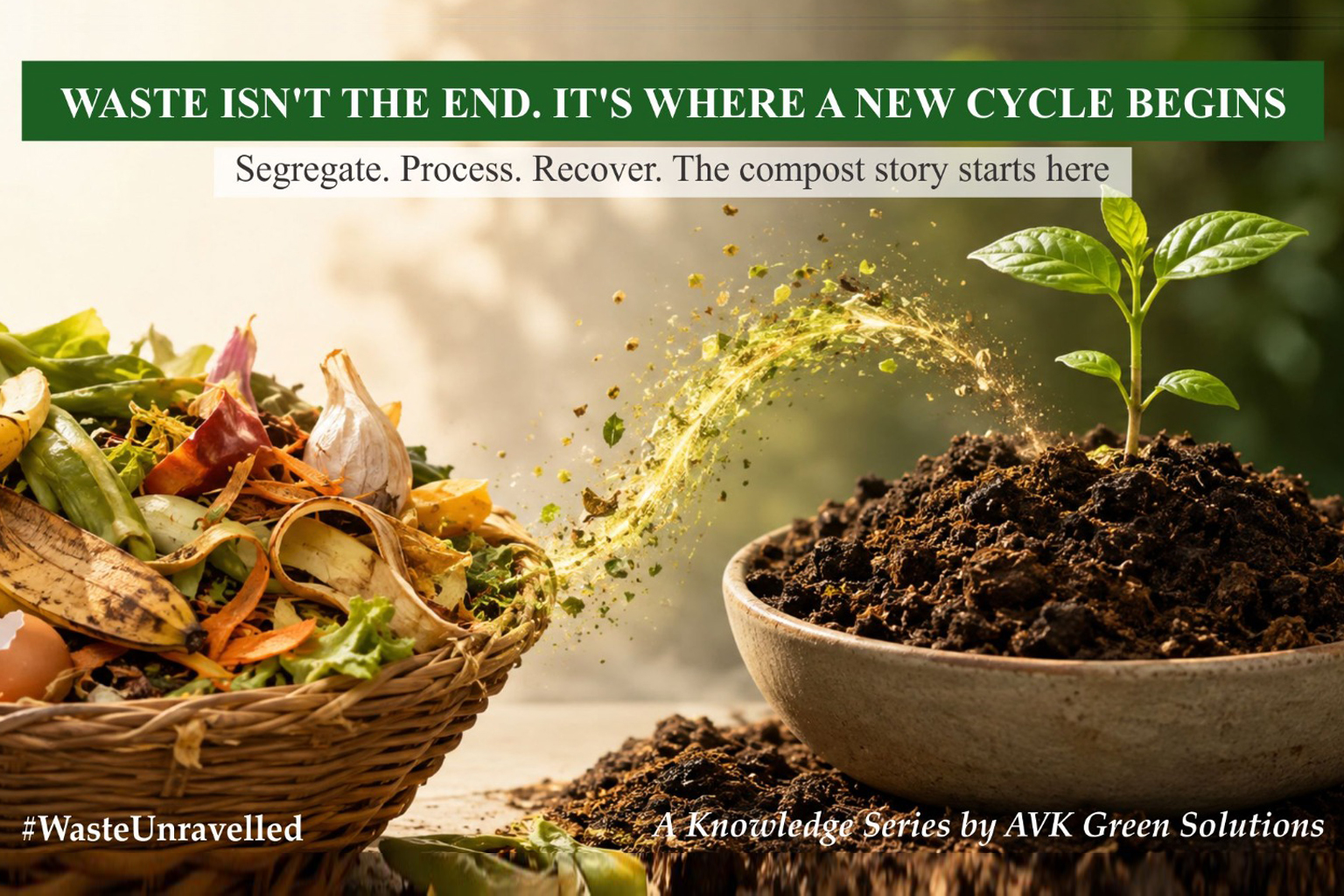
Every day, we throw away vegetable peels, fruit skins, leftover food, flowers and garden waste.
But is it really waste?
Organic waste is biodegradable. With the right process, it can be transformed into a useful resource instead of being sent to a landfill.
This is where composting and biological treatment come in.
What is composting?
Composting is a biological process in which microorganisms break down organic matter and convert it into a stable, nutrient-rich organic material.
In simple terms:
Organic waste + microorganisms + the right conditions = compost
The process depends on factors such as moisture, temperature, microbial activity, aeration and the composition of the waste, but composting does not happen in just one way. Different biological technologies can be used depending on the type and quantity of waste, available space and the desired output.
Three important technologies under SWM Rules 2026
The Solid Waste Management Rules, 2026 recognise different biological processes for managing biodegradable waste. Three important ones are vermicomposting, anaerobic digestion and bio-methanation.
- Vermicomposting
The Rules define vermicomposting as:
“The process of conversion of bio-degradable waste into compost using earthworms.”
In simple terms, earthworms and microorganisms work together to break down biodegradable waste and produce vermicompost.
Vermicomposting is a natural and valuable method of waste treatment. However, it takes considerable time and requires adequate space for the waste to remain in the system while the biological process takes place.
For a Bulk Waste Generator producing organic waste every day, this can become a practical challenge.
- Anaerobic Digestion
The Rules define anaerobic digestion as:
“A controlled process involving microbial decomposition of organic matter in absence of oxygen.”
Unlike conventional aerobic composting, anaerobic digestion takes place without oxygen.
The controlled environment allows microorganisms to break down organic matter and can significantly accelerate biological treatment.
This is the principle behind AVK Green Solutions’ ACCMA™ (Anaerobic Composting by Controlled Microbial Action) technology.
- Bio-methanation
The Rules define bio-methanation as:
“A process which entails enzymatic decomposition of the organic matter by microbial action to produce methane rich biogas.”
Bio-methanation uses microbial action to break down organic matter and produce methane-rich biogas.
It can be an excellent option where there is sufficient waste, space, infrastructure and a practical use for the biogas generated.
But is it practical for every Bulk Waste Generator?
Not necessarily.
Why does the choice of technology matter?
Consider a typical apartment society.
It may generate a substantial amount of kitchen and food waste every day, but have limited space available for waste processing.
The challenge is therefore not simply to find a technology.
It is to find a technology that is:
- Fast enough to handle daily waste generation
- Compact enough for the available space
- Practical to operate
- Suitable for decentralised, on-site processing
- Capable of producing a useful output
The challenge with vermicomposting
Vermicomposting is effective, but it is a relatively slow process.
The waste needs to remain in the system for a significant period before the biological conversion is complete.
For a Bulk Waste Generator, today’s waste does not replace yesterday’s waste—it is added to it.
This means the required processing area can quickly increase.
For smaller apartment communities with limited space, maintaining large vermicomposting areas may therefore not always be practical.
The challenge with bio-methanation
Bio-methanation offers the added benefit of generating methane-rich biogas.
However, it requires appropriate infrastructure, process control and space, along with sufficient feedstock and a practical use for the biogas.
For smaller residential communities, these requirements may make a conventional bio-methanation system less feasible.
Where can ACCMA™ help?
This is where AVK’s ACCMA™ technology offers an alternative.
Based on anaerobic microbial action, ACCMA™ is designed to accelerate the biological treatment of segregated organic waste.
AVK machines and plants can process organic waste in as little as 24 hours, depending on feedstock characteristics and operating conditions.
For Bulk Waste Generators, particularly residential societies with limited space, this can offer a practical way to process wet waste on-site, quickly and with a significantly smaller processing footprint than slower composting methods.
The objective is simple:
Generate → Segregate → Process → Recover
Instead of transporting wet waste away every day, it can be treated closer to where it is generated and converted into a useful organic output.
But technology starts with segregation
No composting or biological treatment technology can compensate for poor segregation.
Plastic wrappers, glass, metal, batteries and other contaminants do not belong with organic waste.
The journey begins at the source:
Segregate → Collect → Process → Recover → Reuse
When organic waste is kept separate, it becomes possible to treat it scientifically and recover its value.
So, which technology is right for you?
There is no single technology that works for every situation.
Vermicomposting can work well where adequate space and time are available.
Bio-methanation can be highly useful where sufficient waste, infrastructure and a use for biogas make the system viable.
Anaerobic digestion-based technologies such as ACCMA™ can provide a practical option for Bulk Waste Generators looking for rapid, decentralised and space-efficient organic-waste processing.
The right solution depends on the quantity of waste, available space, operational requirements and desired outcome.
Waste Unravelled
Composting is not simply about letting waste decompose.
It is about using biology and technology to transform something we call “waste” into something useful.
As the SWM Rules, 2026 place greater emphasis on segregation and responsible processing of wet waste, the question for Bulk Waste Generators is no longer simply:
“Where do we send our wet waste?”
It is:
“How can we process it responsibly, efficiently and as close to the source as possible?”
Because waste doesn’t have to be the end of the cycle.
It can be the beginning of another one.
AVK Green Solutions
Transforming waste into environmental health and wealth.
About Waste Unravelled
Waste Unravelled is a series by AVK Green Solutions that breaks down the world of waste management—one concept at a time.
From composting and segregation to recycling, processing technologies and what really happens to our waste after it leaves our homes, this series aims to make waste management simple, understandable and relevant to everyday life.
Because understanding waste is the first step towards managing it better.
Waste Unravelled — making sense of the waste around us.