Maharashtra Circular Economy Policy 2026: What It Means for Waste Management
Maharashtra is drafting a new circular economy policy to boost recycling, cut pollution, and modernize waste management across Mumbai, Pune and 430 urban local bodies. Here’s what’s inside it.
Maharashtra's New Circular Economy Policy: A Roadmap to Turn Waste into Opportunity
Maharashtra is preparing to table a landmark circular economy policy before the state cabinet, a move aimed at strengthening the recycling industry, curbing pollution and addressing the state’s escalating waste management challenges. The draft policy targets electronic, municipal, solid and plastic waste streams, positioning Maharashtra as a frontrunner in India’s shift toward sustainable resource management.
For sectors like solid waste management (SWM), sustainability consulting and green infrastructure, this policy signals a major shift in how urban local bodies (ULBs), industries and recyclers will operate in the years ahead.
Why Maharashtra Needs a Circular Economy Policy Now?
India generates around 62 million tonnes of waste annually, and the pressure on landfills, municipal systems and industrial recyclers is only intensifying. According to industry estimates cited in the policy discussions, the global circular economy could reach a market size of $2 million by 2050, with the potential to create 10 million jobs, alongside a Rs 10.8 lakh crore investment opportunity in India. Projections also suggest a circular economy could cut greenhouse gas emissions by 39 per cent by 2050, even as annual waste generation is expected to rise 70 per cent over the same period.
These numbers make one thing clear: waste management can no longer be treated as an afterthought. It must become a system that creates economic value through resource recovery, recycling, composting and local employment.
What the Draft Policy on Circular Economy Aims to Do?
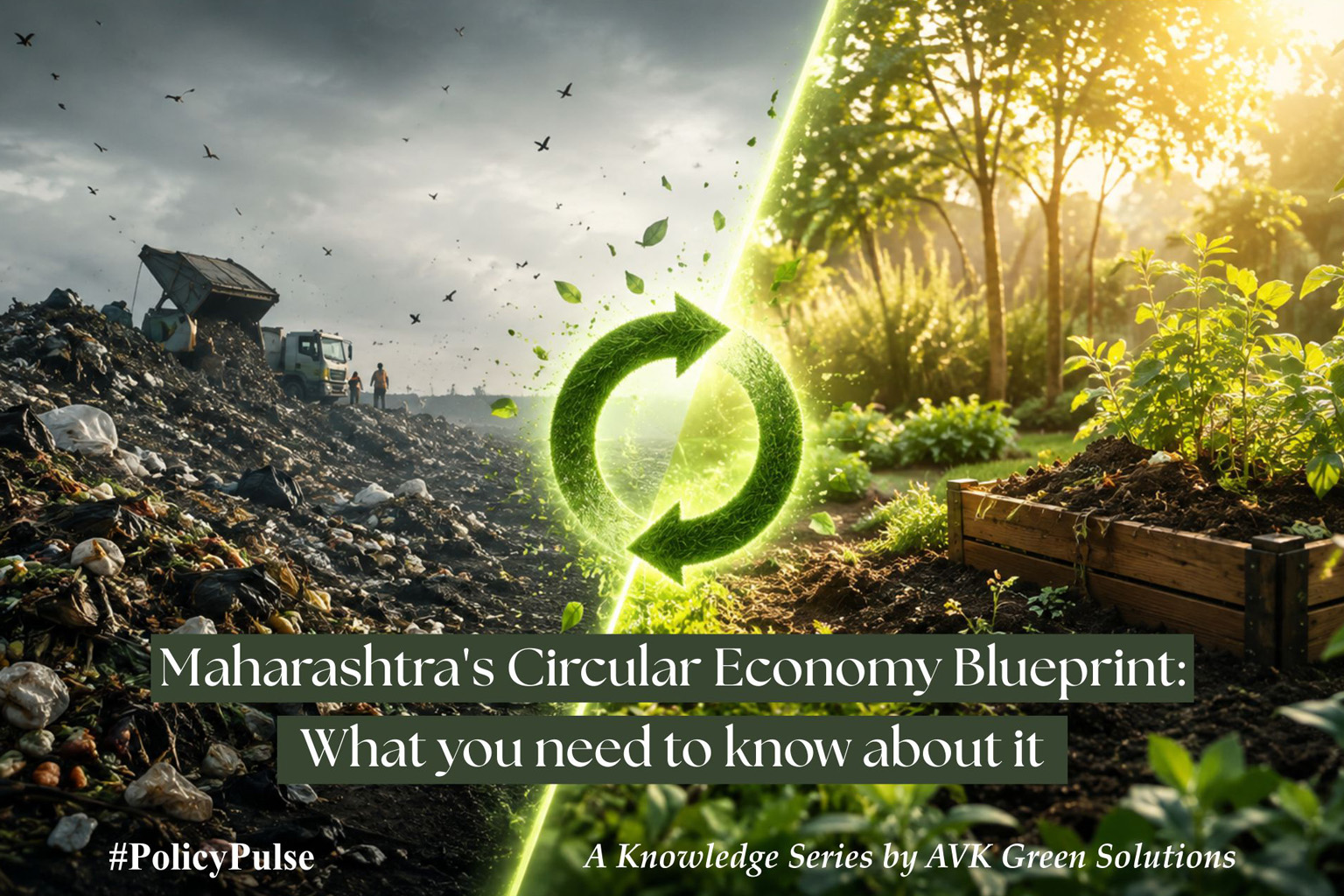
The draft policy is designed to move the state away from a Linear Economy model
Traditional Linear Economy:
- Take → Make → Use → Dispose
and move toward
Circular Economy:
- Reduce → Reuse → Recycle → Recover → Regenerate
Key Pillars of the Policy
- Fiscal and non-fiscal incentives
- Ease-of-doing-business reforms
- Dedicated waste recycling parks
- Revenue generation for municipalities
The Problem the Policy Is Trying to Solve
Mumbai’s Legacy Landfill Crisis
The policy’s urgency becomes clear when you look at sites like Govandi in Mumbai. The Brihanmumbai Municipal Corporation has acknowledged the scale of the challenge in managing waste generated by the city’s 15 million residents plus its large floating population.
The Numbers Across Maharashtra
Maharashtra’s waste management gap is significant at scale:
- 430 urban local bodies across the state generated 24,297 metric tonnes of waste daily in 2025, of which around 82 per cent (19,847 MT) is treated.
- Mumbai alone produces roughly 7,000 metric tonnes of dry and wet waste daily, spanning food and organic matter, wood, textiles, construction debris, plastics, paper, and recyclable metals
- Segregation at source remains poor despite a 5 per cent property tax rebate offered to housing societies that comply.
- Pune generates about 2,800 MT of waste daily, with its Urali Devachi landfill facing environmental concerns and recurring local protests; a 500 MT mixed waste processing plant has since been set up there, alongside biomining of roughly 5.3 million MT of legacy waste.
Why This Matters for Waste Management Stakeholders?
For ULBs, recyclers, and sustainability-focused enterprises, this draft policy could reshape how compliance, infrastructure investment, and municipal partnerships work going forward. A policy environment that rewards scientific waste processing and penalizes legacy dumping creates real incentives for organizations already investing in decentralized composting and resource recovery waste solutions particularly as India’s regulatory landscape around solid waste management continues to tighten.
AVK: Enabling Maharashtra’s Waste Economy
AVK Green Solutions aligns closely with the emerging waste economy by moving beyond the traditional approach of collect, transport, and dispose. Our ACCMA™ technology enables waste to be processed where it is generated, converting organic waste from a recurring disposal cost into a usable resource.
This is the fundamental shift a circular waste economy requires: waste should remain within the economy for as long as possible, rather than being transported to a landfill and lost.
By processing Kitchen, Horticultural, Marketyard, Agro and Water Hyacinth waste at source, AVK helps reduce dependence on waste transportation and landfill infrastructure while creating a continuous local cycle of waste → processing → organic manure → soil → food and green spaces.
The economic value extends beyond the manure itself. Decentralised processing can reduce collection and transportation costs, lower the burden on municipal infrastructure, reduce landfill dependence and create opportunities for local operation, maintenance, landscaping and resource recovery services.
For Maharashtra’s cities, this model is particularly relevant as urbanisation continues to increase waste generation. Instead of continually expanding the infrastructure required to move and dispose of waste, decentralised technologies such as AVK can help create a network of distributed resource-recovery centres across residential communities, institutions, hospitals, commercial establishments, industrial parks and local bodies.
In this sense, AVK is not simply solving the problem of where waste goes. It is helping answer a more important question:
How can the waste we generate become part of the economy again?
- That is where AVK’s model fits naturally into Maharashtra’s waste economy — turning organic waste into a resource, reducing recurring costs, creating local value, and making circularity practical at the point of generation.
Take Action Today
- Maharashtra has established the legal framework, capital incentives and enforcement mechanisms. The technology is proven, scalable and ready for deployment.
- Partner with AVK Green Solutions to make your facility 100% compliant, zero-waste and environmentally resilient.
- Contact AVK Green Solutions today to request a site audit and tailored waste management strategy. We will quantify your organic waste stream, recommend the right AVK system for your scale and guide your government subsidy application — turning compliance into a daily sustainability asset.
About Policy Pulse
Policy Pulse is a knowledge series by AVK Green Solutions, breaking down the policies shaping India’s waste and environmental landscape. We simplify what’s changing, why it matters, and what it means for communities, businesses, and institutions.