Compliance Corner #1
The Four-Way Waste Segregation System Explained: What Every Residential Society Needs to Know Under the SWM Rules, 2026
“Compliance begins with segregation. Without it, no waste management system can be successful.
Imagine preparing a traditional Indian thali by serving dal, rice, pickle, dessert, and curd all mixed together in one bowl. While the ingredients may be the same, combining them destroys their individual taste, texture, and purpose.
Waste is no different.
Every type of waste has a different destination. Kitchen waste can be converted into compost, recyclable materials can be recovered, sanitary waste requires safe handling, and hazardous waste needs specialised disposal. When everything is mixed together, valuable resources are lost and the entire waste management system becomes less effective.
Recognising this, the Solid Waste Management Rules, 2026 place greater emphasis on four-way segregation at source, ensuring that each type of waste can be managed in the most appropriate and sustainable way.
What is Four-Way Waste Segregation?
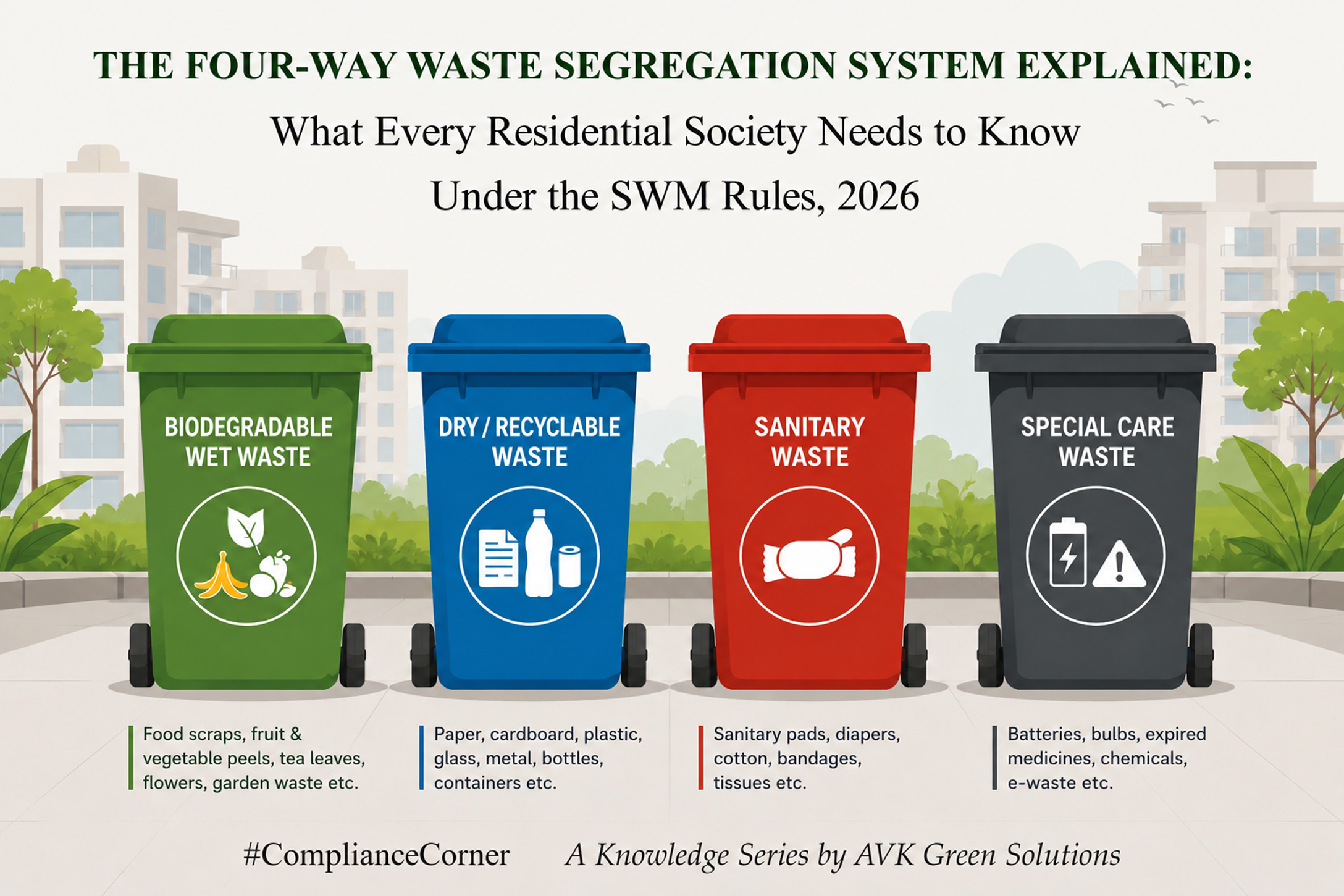
The SWM Rules, 2026 require waste to be separated into four distinct categories before it leaves your home.
Biodegradable (Wet) Waste
This is organic waste that naturally decomposes and can be converted into compost.
Examples include:
- Fruit and vegetable peels
- Leftover food
- Tea leaves and coffee grounds
- Eggshells
- Garden waste
- Flowers and leaves
Recommended bin: Green
Dry Waste (Recyclables)
These materials can be recovered and recycled when kept clean and dry.
Examples include:
- Paper and cardboard
- Plastic bottles and containers
- Glass bottles
- Metal cans
- Cartons
- Clean packaging material
Recommended bin: Blue
Sanitary Waste
Sanitary waste requires careful handling to protect waste collectors and prevent contamination.
Examples include:
- Used diapers
- Sanitary pads
- Tampons
- Bandages
- Cotton swabs
- Disposable tissues contaminated with bodily fluids
These items should be securely wrapped before disposal.
Recommended bin: Red (or as prescribed by your local authority)
Special Care (Domestic Hazardous) Waste
Although generated in smaller quantities, these materials require separate collection because they can harm people or the environment.
Examples include:
- Batteries
- CFLs and tube lights
- Paint containers
- Expired medicines
- Aerosol cans
- E-waste
- Chemical containers
Never mix these with household waste.
Why Four-Way Segregation Matters
Segregation is more than a compliance requirement,it is the foundation of an efficient waste management system.
When waste is segregated:
- Organic waste can be processed into compost.
- Recyclable materials retain their value and are easier to recover.
- Hazardous materials are handled safely.
- The volume of waste sent to landfills is significantly reduced.
- Municipal waste collection becomes more efficient.
What This Means for Residential Societies
For residential societies, implementing four-way segregation is often the first and most important step toward compliance with the SWM Rules, 2026.
Success depends on:
- Clearly labelled bins throughout the premises.
- Resident awareness and participation.
- Regular training for housekeeping staff.
- Periodic monitoring and feedback.
Compliance is not achieved by installing more bins alone,it requires consistent participation from every household.
Compliance Tip of the Week
Walk through your society today and ask one simple question: Are residents truly segregating waste into four categories before handing it over?
If the answer is no, now is the right time to start. Every correctly segregated bag of waste brings your community one step closer to compliance and contributes to a cleaner, healthier, and more sustainable neighbourhood.
About Compliance Corner
Compliance Corner is a knowledge series by AVK Green Solutions, simplifying the Solid Waste Management Rules, 2026 into practical guidance for residential societies, facility managers, businesses, and institutions. Our goal is to help communities understand the “why” behind the rules and take informed steps toward sustainable waste management.